Exercise
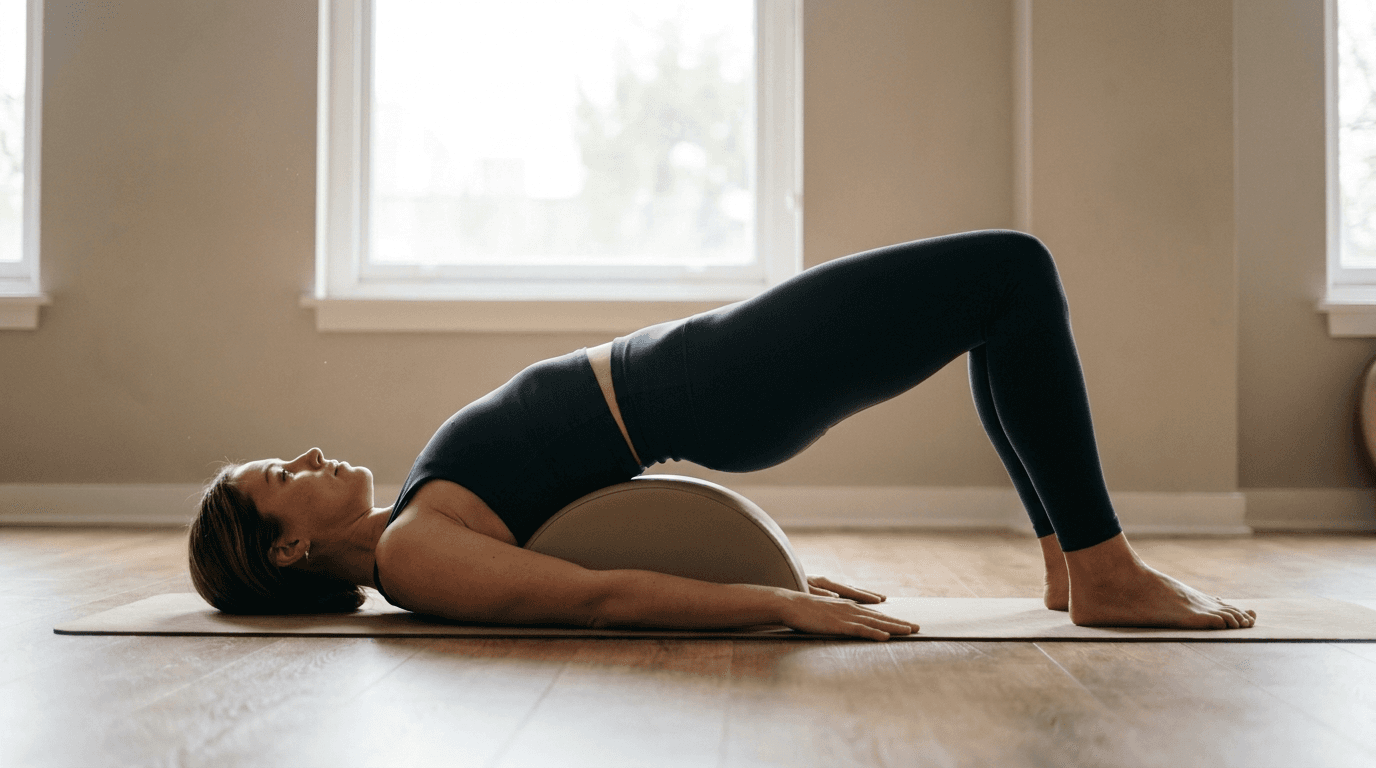
Supine Spine Corrector bridge exercise with the lower back supported by the barrel curve for guided spinal articulation and glute strength.
Setup instructions
Sit on the far edge of the Spine Corrector and recline so the lower back is supported by the barrel curve. Place the feet flat on the floor with knees bent and hip-width apart. Rest the arms by the sides.
Breathing cues
Exhale to lift. Inhale to hold. Exhale to lower.
Movement steps
- 1Inhale to prepare.
- 2Exhale to tilt the pelvis and begin articulating the spine off the barrel.
- 3Lift into a bridge, pressing through the feet and engaging the glutes.
- 4Inhale to hold briefly at the top.
- 5Exhale to roll the spine back down over the barrel with control.
Common mistakes
Overarching the low back at the top; rushing the articulation; letting the knees drift; losing foot connection to the floor.
Safety notes
The barrel will push the spine into greater extension at the top — keep the abdominals active to prevent overarching. Avoid if low-back pain appears.
Connections
Muscles worked
Goals supported
Equipment needed
Related exercises
FAQs
Is Spine Corrector Pelvic Curl suitable for beginners?
Yes. The barrel supports the lower back and guides the articulation, making this a beginner-friendly variation of the bridge. The support helps those who struggle to feel sequential spinal movement on the flat mat.
What muscles does Spine Corrector Pelvic Curl work?
The glutes and hamstrings do most of the work on the lift. The core articulates the spine, and the abdominals work at the top to prevent overarching against the barrel curve.
What is Spine Corrector Pelvic Curl good for?
It develops glute strength, spinal articulation, and the awareness of sequential vertebral movement that is harder to feel on the flat mat. The barrel provides a tactile guide for each segment of the spine.
Plan your class
Turn saved exercises into a class plan
Save exercises from the library, then build a reformer class plan with cues, timings, reps, and teaching notes.