Guide · Equipment & apparatus
Reformer Pilates Equipment Guide
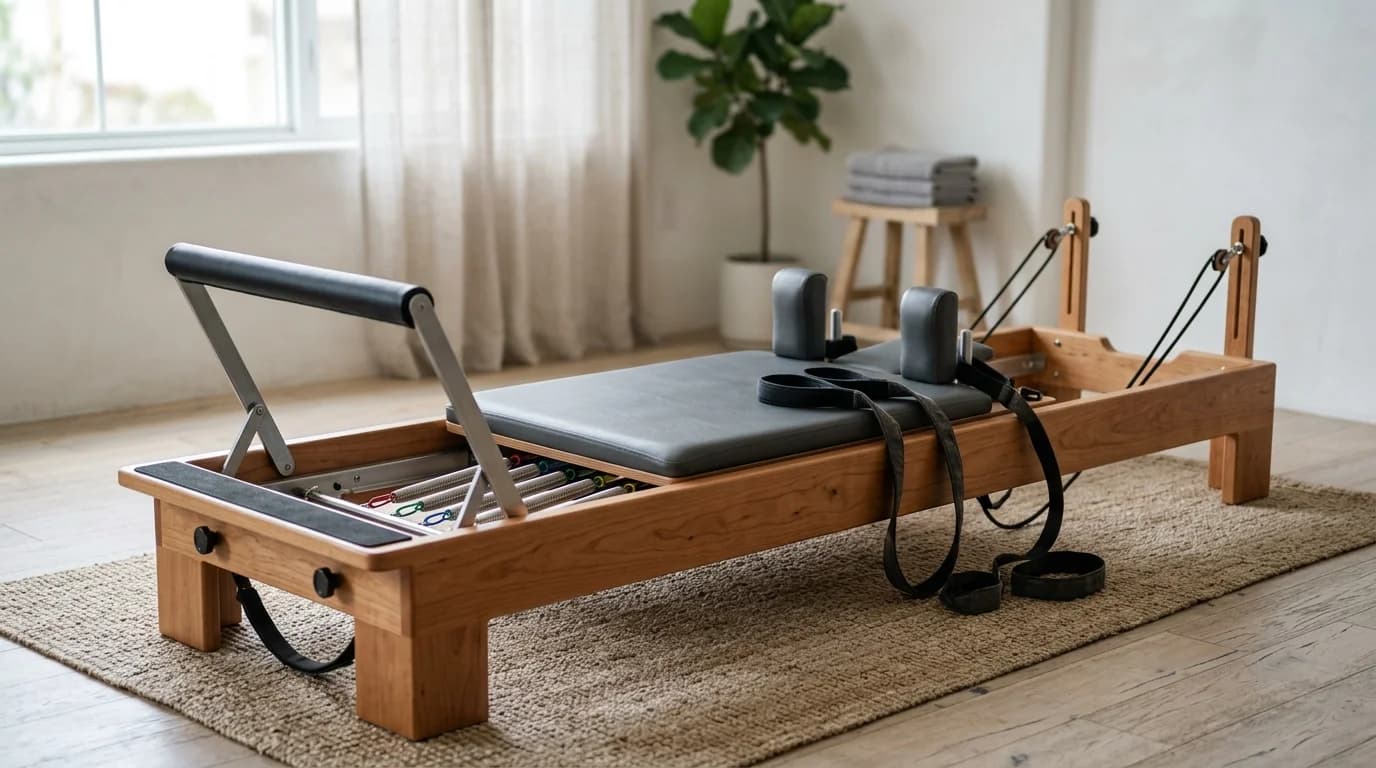
Reformer Pilates uses a moving machine with springs, a carriage, a footbar, straps, and sometimes additional props such as a long box or Pilates ring. This guide explains the main equipment beginners are likely to see…
This guide is for educational discovery only. If you have pain, an injury, pregnancy, postnatal considerations, or a specific medical concern, speak to a qualified Pilates instructor or appropriate healthcare professional before trying new exercises.
Quick Answer
The main equipment used in reformer Pilates is the reformer, which usually includes a moving carriage, springs, a footbar, shoulder blocks, and straps. Beginners may also use accessories such as a long box or Pilates ring. Each part changes how an exercise feels, so beginners should learn setup and spring choices with instructor guidance.
Who This Guide Is For
This guide may be useful if you:
- are new to reformer Pilates and want to understand the machine
- have seen reformer equipment in a studio and want to know what each part does
- want to understand the difference between footbar, strap, long box, and ring exercises
- are preparing for your first class
- want to browse exercises by equipment type
- want better questions to ask an instructor before trying new movements
The reformer can look complicated at first. The aim of this page is to make the equipment feel less mysterious, not to teach you how to set it up without instruction.
What Equipment Is Used In Reformer Pilates?
The core piece of equipment is the reformer machine. It usually has a moving carriage that glides along rails, springs that create resistance or support, a footbar, straps, shoulder blocks, and a headrest.
Depending on the studio, class, and exercise, you may also see accessories such as a long box, a short box, a Pilates ring, poles, pads, or other props. This site currently focuses on the main equipment entities that connect directly to the exercise library:
For beginners, the most important thing is not memorising every part. It is understanding that the equipment changes support, resistance, range, and feedback.
The Reformer Machine
The reformer is the main apparatus used in reformer Pilates. It provides the structure for the exercise: the moving carriage, spring system, footbar, straps, and support points.
For beginners, the reformer does two useful things. It can support the body in certain positions, and it can also make movement more challenging by asking the user to control the carriage or straps.
That is why the same reformer can feel supportive in one exercise and demanding in another. The experience depends on:
- the exercise selected
- the spring setting
- body position
- range of movement
- whether the footbar or straps are used
- the instructor’s cues
Useful exercise pages:
The Carriage
The carriage is the moving platform on the reformer. It slides in and out as the user pushes, pulls, or controls movement against the springs.
For beginners, the carriage is often the first thing that feels unusual. If the carriage moves too quickly, returns with a bang, or feels hard to control, it may be a sign that the user is rushing or needs a different setup.
Exercises such as Footwork Series are useful because they let beginners feel carriage movement with the support of the footbar. This makes the feedback easier to understand.
Beginner focus points:
- move the carriage with control
- avoid relying on momentum
- return the carriage smoothly
- listen to instructor cues about range
- ask if the spring setting feels too heavy or too unstable
Springs And Resistance
Springs create resistance, but they can also provide support. This is one of the most misunderstood parts of reformer Pilates.
Beginners often assume heavier springs are harder and lighter springs are easier. Sometimes that is true, but not always. In some exercises, heavier springs may make the carriage feel more stable. In other exercises, lighter springs may demand more control because the carriage is less supported.
The right spring setting depends on the exercise, the machine, the body position, and the user’s level. That is why beginners should follow instructor guidance rather than guessing.
Useful questions to ask:
- Which spring setting should I use for this exercise?
- Is this spring setting giving support or adding challenge?
- Should the carriage feel stable or mobile here?
- What should I do if the carriage moves too quickly?
The Footbar
The footbar is a bar at one end of the reformer. It is commonly used as a stable contact point for the feet or hands.
For beginners, the footbar is often one of the easiest parts of the reformer to understand because it gives a clear place to press from. Exercises such as Footwork Series use the footbar to introduce lower-body alignment, foot placement, and controlled carriage movement.
The footbar can help users explore:
- foot placement
- leg alignment
- glute and hamstring involvement
- controlled pressing and returning
- how spring resistance changes the movement
Useful exercise pages:
Straps And Loops
Straps are attached to the reformer pulley system and are commonly used for leg or arm movements. They may be used with hands, feet, or sometimes other positions depending on the exercise.
For beginners, straps can feel strange at first because they move with the springs and require control. They may feel supportive in one exercise and demanding in another.
A useful beginner strap exercise is Frog in Straps. It introduces controlled leg movement while the user works to keep the pelvis and trunk organised. Leg Circles in Straps may be a more demanding progression depending on range, control, and instructor setup.
Strap exercises can help users explore:
- hip movement
- coordination
- trunk and pelvic control
- range of movement
- spring feedback
Useful exercise pages:
The Long Box
The long box is an accessory placed on the reformer carriage. It changes the user’s position and can support exercises performed lying, sitting, or kneeling on the box.
Long box exercises can feel different from standard carriage exercises because the body is lifted and positioned differently. They may involve pulling straps, upper-back work, shoulder control, or trunk support.
A relevant page in the current library is Long Box Pulling Straps. This exercise connects to upper-back awareness, posture support, and strap control.
For beginners, long box work should be introduced carefully. The box changes the setup, and some exercises may require more coordination or shoulder control than basic footbar work.
Useful exercise page:
Related guide:
The Pilates Ring
The Pilates ring, sometimes called a magic circle, is an accessory that can provide tactile feedback. It is not part of the reformer itself, but it may be used during reformer exercises.
The ring can help users notice pressure, alignment, arm position, shoulder organisation, or trunk support. It is not only for making an exercise harder; sometimes it is useful because it gives the user something clear to feel.
A relevant exercise in the current library is Kneeling Arm Press with Pilates Ring. This can connect to shoulder control, upper back awareness, and upright trunk support.
Useful exercise page:
Related guide:
Beginner Exercises By Equipment
Exercises using the footbar
The footbar is often a good starting point because it gives a stable contact point.
Useful pages:
Exercises using straps
Strap exercises can help users explore control, range, and coordination.
Useful pages:
Exercises using the long box
Long box exercises change the body position and often connect to upper-back or shoulder-control work.
Useful pages:
Exercises using the Pilates ring
Ring exercises can provide feedback for arm, shoulder, or trunk-control work.
Useful pages:
Common Equipment Mistakes
Assuming the spring setting is obvious
Spring settings are not universal. They vary by exercise, machine, studio, and user. Beginners should ask rather than guess.
Thinking heavier springs are always harder
Heavier springs may add resistance, but they can also provide stability. Lighter springs can sometimes make an exercise more challenging because the carriage is less supported.
Rushing the carriage
The moving carriage gives useful feedback. If it moves too quickly or returns abruptly, the user may need to slow down, reduce range, or ask for a spring adjustment.
Ignoring strap setup
Strap length, loop choice, and body position can change how an exercise feels. Beginners should wait for clear setup guidance before starting strap exercises.
Treating props as optional extras only
Accessories such as the long box or Pilates ring are not just add-ons. They can change body position, feedback, and exercise focus.
What To Ask An Instructor
Useful equipment questions include:
- Which springs should I use for this exercise?
- Is this setting giving support or adding challenge?
- Where should my feet or hands go?
- Which loop should I use on the straps?
- Should the carriage move a lot or only a little?
- How do I know if the box is positioned correctly?
- What should I feel when using the Pilates ring?
- What should I do if the equipment feels unstable?
If you are new to the reformer, it is completely reasonable to ask for a setup explanation before each exercise.
FAQs
What equipment is used in reformer Pilates?
The main equipment is the reformer, which usually includes a moving carriage, springs, a footbar, shoulder blocks, and straps. Some exercises also use accessories such as a long box or Pilates ring.
What does the footbar do on a reformer?
The footbar gives the feet or hands a stable contact point. It is commonly used in beginner exercises such as Footwork Series, where it helps users explore foot placement, lower-body alignment, and carriage control.
What are reformer straps used for?
Straps are used for arm or leg movements. They connect to the reformer pulley and spring system, so they provide both resistance and feedback. Beginner strap exercises include Frog in Straps, while other strap exercises may require more control or range.
Are heavier springs harder in reformer Pilates?
Not always. Heavier springs can create more resistance, but they can also make the carriage feel more supported. Lighter springs can sometimes be more challenging because they require more control. Beginners should follow instructor guidance for spring settings.
What is the long box used for?
The long box is placed on the reformer carriage to change body position. It may be used for exercises involving straps, upper-back work, shoulder control, or trunk support. A current example is Long Box Pulling Straps.
What is a Pilates ring used for on the reformer?
The Pilates ring can provide feedback during arm, shoulder, or trunk-control exercises. It may help users notice pressure, alignment, and control. A relevant exercise is Kneeling Arm Press with Pilates Ring.
Do beginners need to know all the reformer equipment before class?
No. Beginners do not need to memorise every part before class. It is useful to understand the main pieces — reformer, carriage, springs, footbar, and straps — but the instructor should explain setup and spring choices during the session.
Where should I start if I am new to the equipment?
Start with Reformer Pilates for Beginners for the wider overview, then explore Beginner Reformer Pilates Exercises. For equipment-specific examples, begin with Footwork Series for the footbar and Frog in Straps for straps.