Exercise
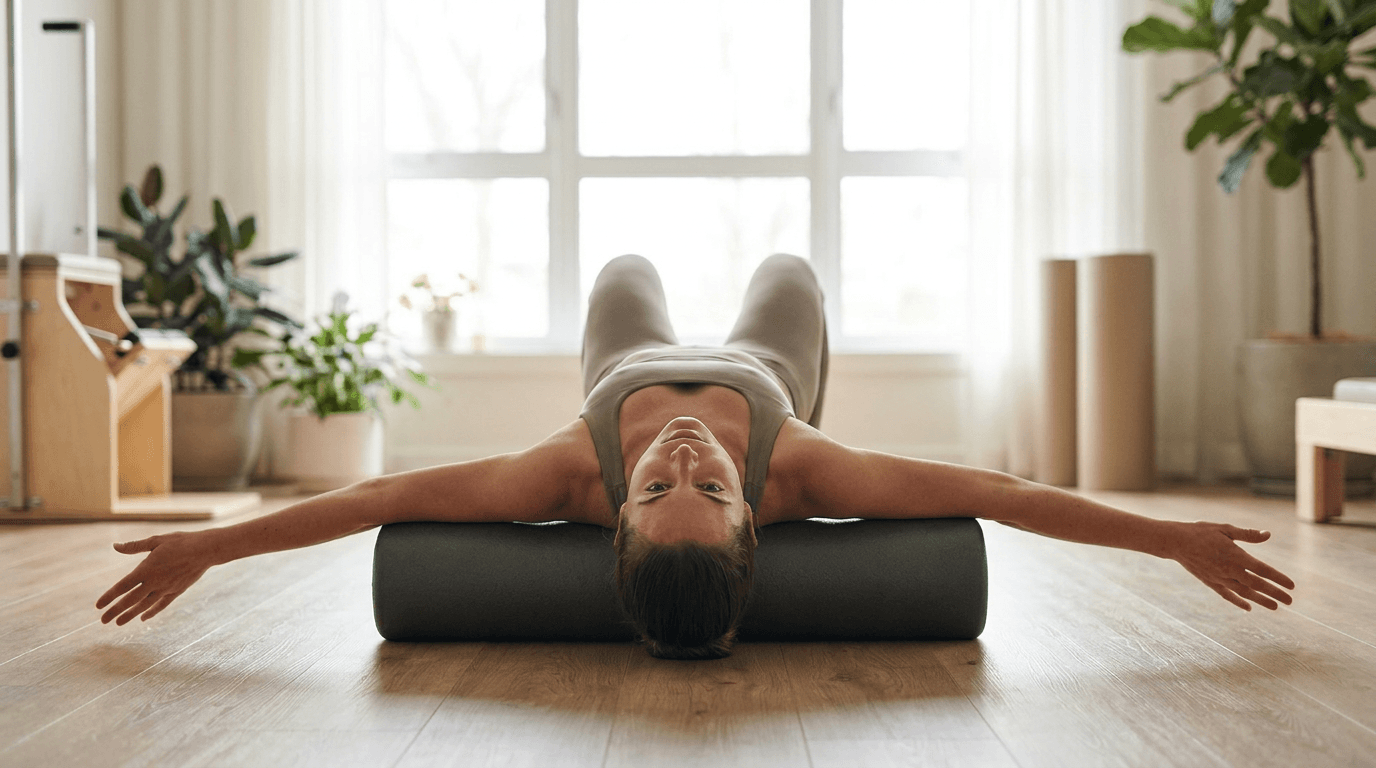
Supine balance exercise lying along a foam roller to challenge core stability and develop body awareness on an unstable surface.
Setup instructions
Place the foam roller lengthways on the mat. Sit at one end of the roller and slowly lie back so the full length of the spine rests on the roller. Place the feet flat on the floor hip-width apart with knees bent and arms out wide for support.
Breathing cues
Breathe steadily throughout.
Movement steps
- 1Inhale to find balance on the roller.
- 2Exhale to release the arms slightly from the floor, challenging the balance further.
- 3Hold the position with the core gently active and the body balanced centrally.
- 4Breathe steadily throughout the hold.
- 5Increase the challenge progressively by reducing arm support.
Common mistakes
Rolling off to one side; tensing the shoulders aggressively; holding the breath; trying to progress too quickly.
Safety notes
Keep arms nearby for safety when first learning. Stop if balance cannot be maintained. Avoid with acute back pain or significant balance impairment.
Connections
Related exercises
FAQs
Is Foam Roller Balance suitable for beginners?
Yes. Lying supine on the roller is a passive starting position where the arms can stay wide on the floor for full support. The challenge increases gradually as arm support is reduced.
What muscles does Foam Roller Balance work?
The deep core stabilisers — particularly the transverse abdominis — work continuously to maintain balance on the unstable surface. The shoulder stabilisers assist in managing the arm position.
What is Foam Roller Balance good for?
It develops deep core activation and proprioceptive awareness in a gentle, supported way. It is also a useful setup position that prepares the body for more demanding foam roller exercises like Dead Bug and chest work.
Plan your class
Turn saved exercises into a class plan
Save exercises from the library, then build a reformer class plan with cues, timings, reps, and teaching notes.