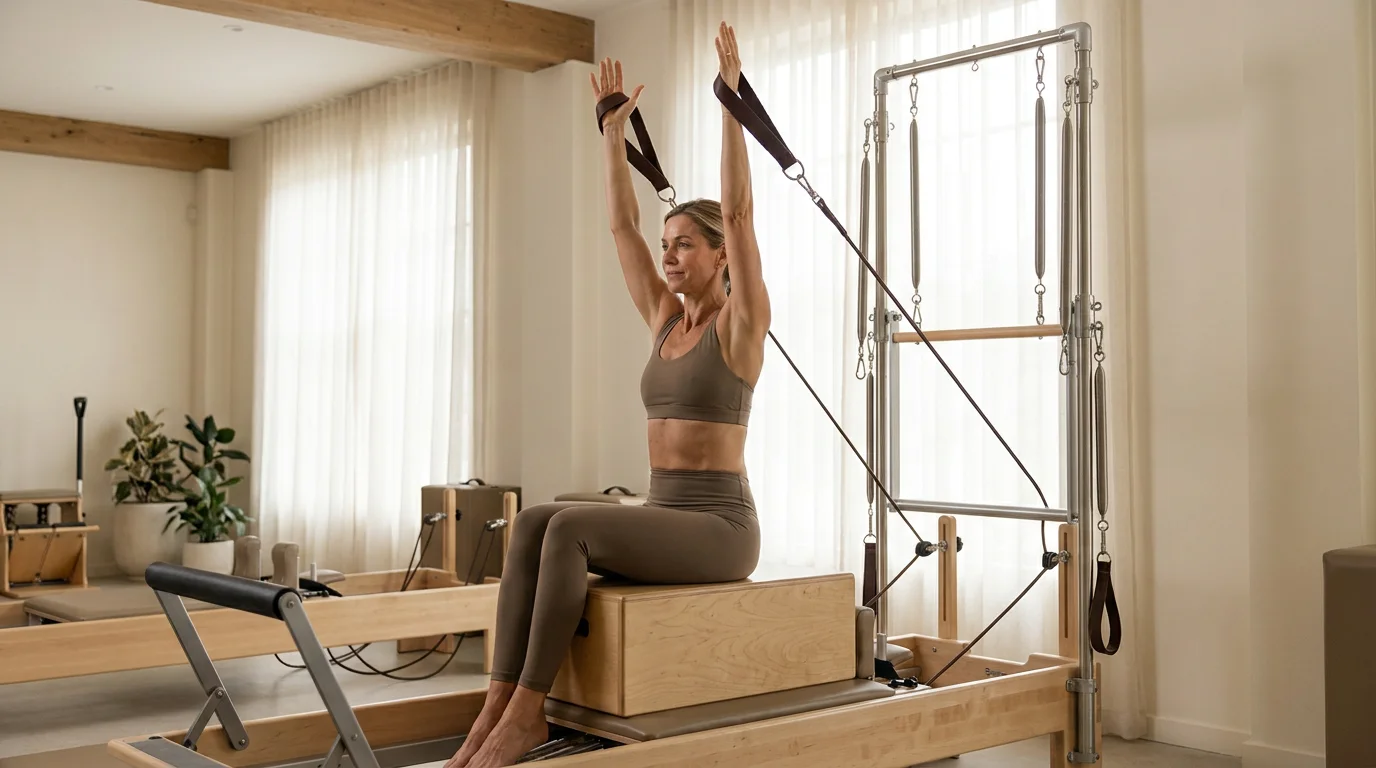
Exercise
Advanced seated balance on the long box holding the straps overhead for trunk and hip stability.
Setup instructions
Sit upright on the long box facing the footbar. Hold the straps overhead with arms straight and shoulders settled. Find a tall spine and connect the abdominals before beginning.
Breathing cues
Inhale to prepare and grow tall. Exhale to deepen abdominal engagement and hold.
Movement steps
- 1Inhale to prepare, growing tall through the crown.
- 2Exhale to deepen the abdominal connection and hold the balance steady.
- 3Keep the straps taut and the arms long as the balance settles.
- 4Maintain upright trunk without tipping the pelvis or gripping the box.
Common mistakes
Collapsing the trunk backward; gripping the straps too tightly; letting the shoulders rise; losing the upright pelvis.
Safety notes
Requires strong trunk and shoulder stability. Use a spotter when learning. Avoid with shoulder or balance issues.
Connections
Muscles worked
Goals supported
Related exercises
FAQs
Is Horseback suitable for beginners?
No. Horseback requires exceptional trunk stability and shoulder control. It is best approached after establishing strong reformer foundations and a reliable seated balance on the box.
What muscles does Horseback work?
Horseback primarily challenges the deep abdominals and hip flexors to maintain the seated balance. The upper back and shoulder stabilisers work to keep the straps lifted overhead.
What is Horseback good for?
Horseback builds advanced seated balance, deep core strength, and shoulder stability. It is a useful exercise for Pilates practitioners developing full-body control on the reformer.
Why is this exercise called Horseback?
The name comes from the upright seated position with legs straddling the long box, which resembles sitting on a horse. The arm position holding the straps overhead adds an elegant upper-body challenge.
Plan your class
Turn saved exercises into a class plan
Save exercises from the library, then build a reformer class plan with cues, timings, reps, and teaching notes.