Exercise
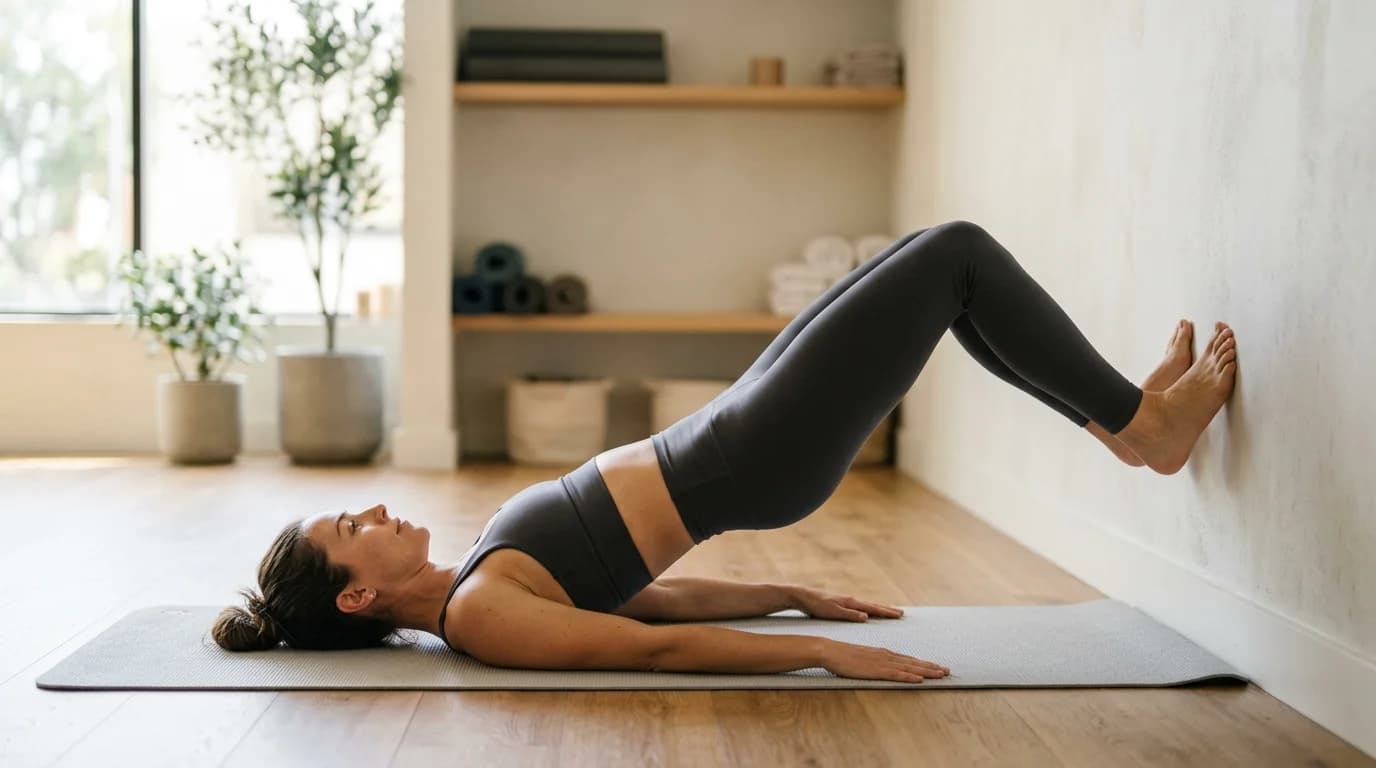
Supine bridge with the feet on a studio wall for glute and hamstring engagement with stable foot feedback.
Setup instructions
Lie supine on the mat with the hips close enough to the wall to place both feet flat on it. Position the feet hip-width apart on the wall with knees bent to roughly 90 degrees. Rest the arms by the sides with palms down. Find a neutral pelvis and engage the core gently before lifting.
Breathing cues
Exhale to lift. Inhale to hold. Exhale to lower.
Movement steps
- 1Inhale to prepare.
- 2Exhale to press the feet into the wall and lift the hips to a comfortable bridge height.
- 3Hold briefly at the top with even glute engagement and level hips.
- 4Inhale to maintain the position with steady breath.
- 5Exhale to lower the hips with control and repeat.
Common mistakes
Pushing the feet too high on the wall; overarching the low back; letting the knees fall inward; rushing the descent; holding the breath.
Safety notes
Keep the bridge range modest until control feels clear. Stop if knee, hip, or sharp back discomfort appears.
Connections
Muscles worked
Goals supported
Related exercises
FAQs
Is Wall Bridge suitable for beginners?
Yes. The wall gives a stable foot platform that often makes the bridge easier to control than feet on the mat alone. Range can stay modest at first.
What muscles does Wall Bridge work?
The glutes and hamstrings drive the hip lift while the deep abdominals stabilise the pelvis. Feet pressing into the wall provide clear feedback for even loading.
What is Wall Bridge good for?
It builds accessible posterior-chain strength and hip extension before reformer footwork and classical mat bridge progressions.
How is Wall Bridge different from Wall Pelvic Curl?
Wall Bridge emphasises a steady hip lift and hold, while Wall Pelvic Curl focuses on rolling the spine through articulation. Both use feet on the wall but train different movement qualities.
Plan your class
Turn saved exercises into a class plan
Save exercises from the library, then build a reformer class plan with cues, timings, reps, and teaching notes.