Exercise
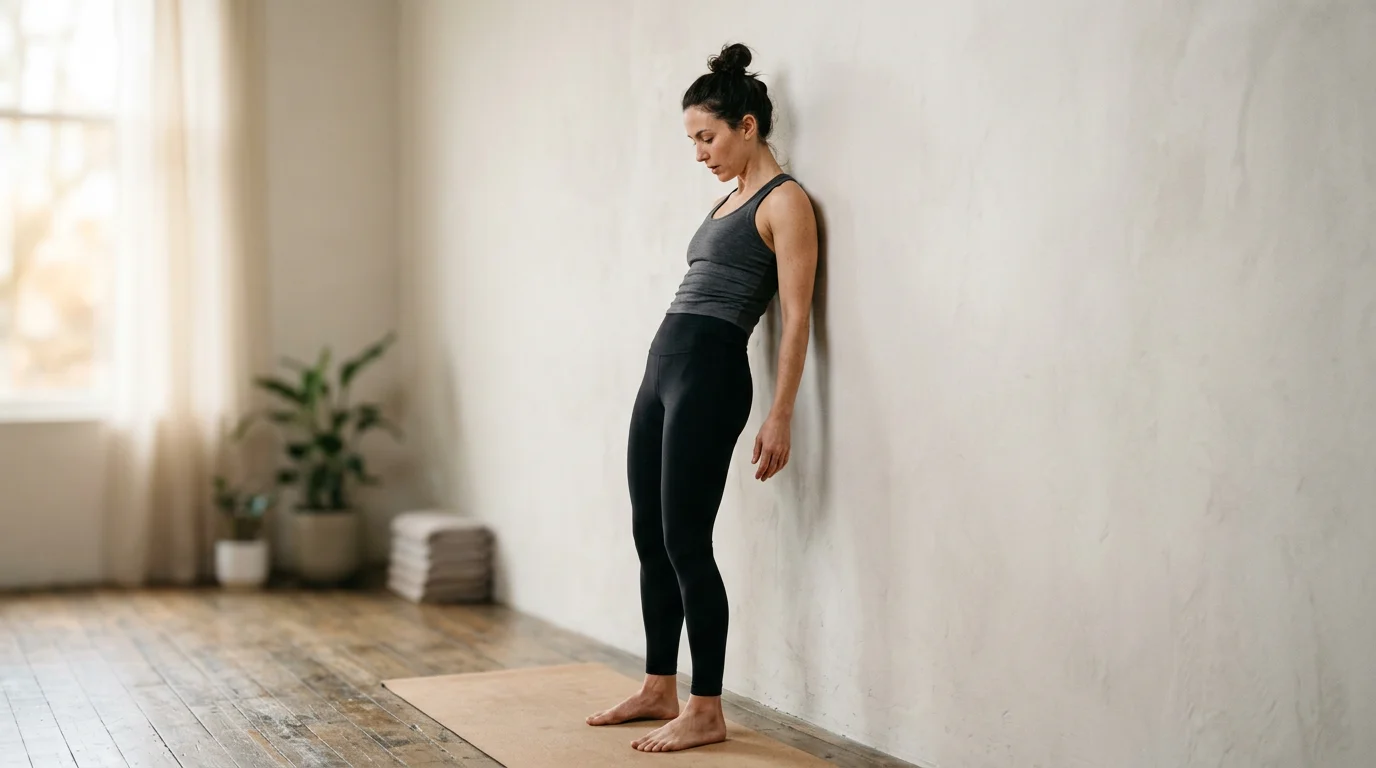
Standing spinal articulation against a studio wall for posture awareness and controlled flexion.
Setup instructions
Stand with your back against a plain studio wall. Place feet hip-width apart a comfortable distance from the wall. Let the head, upper back, and pelvis lightly touch the wall. Rest the arms by the sides and soften the knees.
Breathing cues
Exhale to roll down. Inhale at the bottom. Exhale to roll up.
Movement steps
- 1Inhale to lengthen through the crown of the head.
- 2Exhale to nod the chin and peel the upper spine away from the wall one segment at a time.
- 3Pause at a comfortable range without forcing the low back off the wall.
- 4Inhale at the bottom with the head heavy.
- 5Exhale to stack the spine back up against the wall with control.
Common mistakes
Dropping straight from the hips instead of articulating; forcing the low back off the wall; locking the knees; rushing the return; letting the shoulders lift.
Safety notes
Keep the range small at first. Stop if dizzy, neck tension, or sharp back discomfort appears. Move slowly in and out of the rolled position.
Connections
Muscles worked
Goals supported
Equipment needed
Related exercises
FAQs
Is Wall Roll Down suitable for beginners?
Yes. The wall provides clear feedback that helps beginners understand spinal articulation without needing apparatus. Keep the range small until the movement feels smooth.
What muscles does Wall Roll Down work?
The deep abdominals guide the spinal flexion and return. The hamstrings lengthen at the bottom of the range, and the upper-back muscles help maintain alignment against the wall.
What is Wall Roll Down good for?
It teaches sequential spinal flexion, posture awareness, and the roll-down pattern that supports mat roll-ups, standing roll-downs, and many Pilates flexion sequences.
How is Wall Roll Down different from a mat roll down?
The wall gives continuous feedback along the back, which can make it easier to feel where each spinal segment moves. The mat version removes that external guide and demands more self-organisation.
Plan your class
Turn saved exercises into a class plan
Save exercises from the library, then build a reformer class plan with cues, timings, reps, and teaching notes.