Exercise
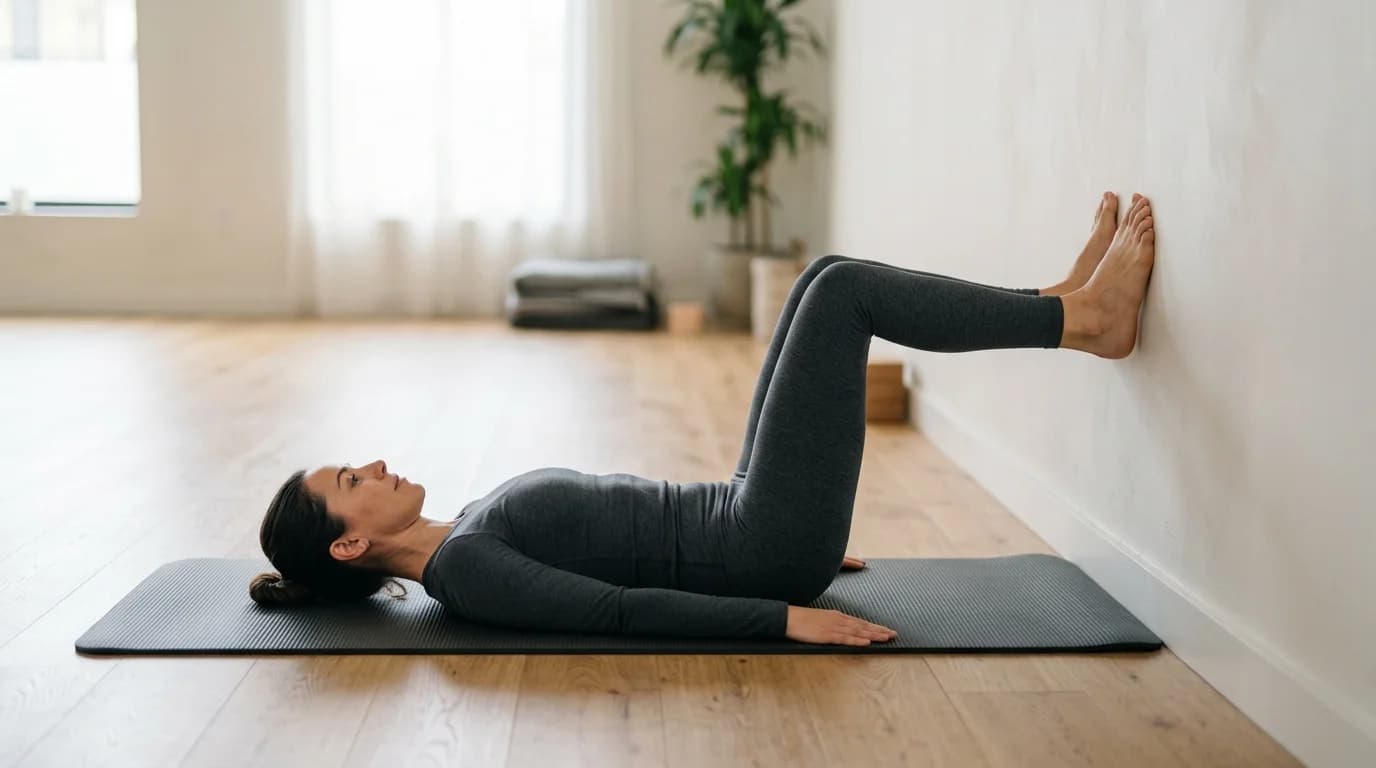
Supine tabletop hold with the feet pressing lightly into a studio wall for pelvic stability and core endurance.
Setup instructions
Lie supine on the mat with the hips close enough to the wall to place both feet flat on it. Lift the knees to tabletop with shins parallel to the floor. Rest the arms by the sides or reach them toward the ceiling. Press the feet lightly into the wall without losing neutral pelvis.
Breathing cues
Breathe steadily throughout the hold.
Movement steps
- 1Inhale to prepare in tabletop.
- 2Exhale to deepen core engagement and maintain the hold.
- 3Keep the low back gently supported on the mat.
- 4Breathe steadily for several counts.
- 5Release with control when the hold ends.
Common mistakes
Pressing the feet too forcefully into the wall; letting the low back arch; hiking the shoulders; holding the breath; allowing the knees to drift wider than hip width.
Safety notes
Start with short holds and build endurance gradually. Stop if sharp back discomfort or hip pinching appears.
Connections
Muscles worked
Goals supported
Related exercises
FAQs
Is Wall Tabletop Hold suitable for beginners?
Yes. It is a simple isometric hold with clear wall feedback. Start with short holds and build endurance gradually.
What muscles does Wall Tabletop Hold work?
The deep abdominals maintain pelvic stability while the hip flexors hold the legs in tabletop against light wall pressure.
What is Wall Tabletop Hold good for?
It develops core endurance and pelvic stability as a stepping stone before dead bug, marching, and reformer abdominal patterns.
How long should I hold Wall Tabletop?
Begin with 10 to 20 seconds and build toward 30 seconds or more as control improves. Quality of alignment matters more than duration.
Plan your class
Turn saved exercises into a class plan
Save exercises from the library, then build a reformer class plan with cues, timings, reps, and teaching notes.