Exercise
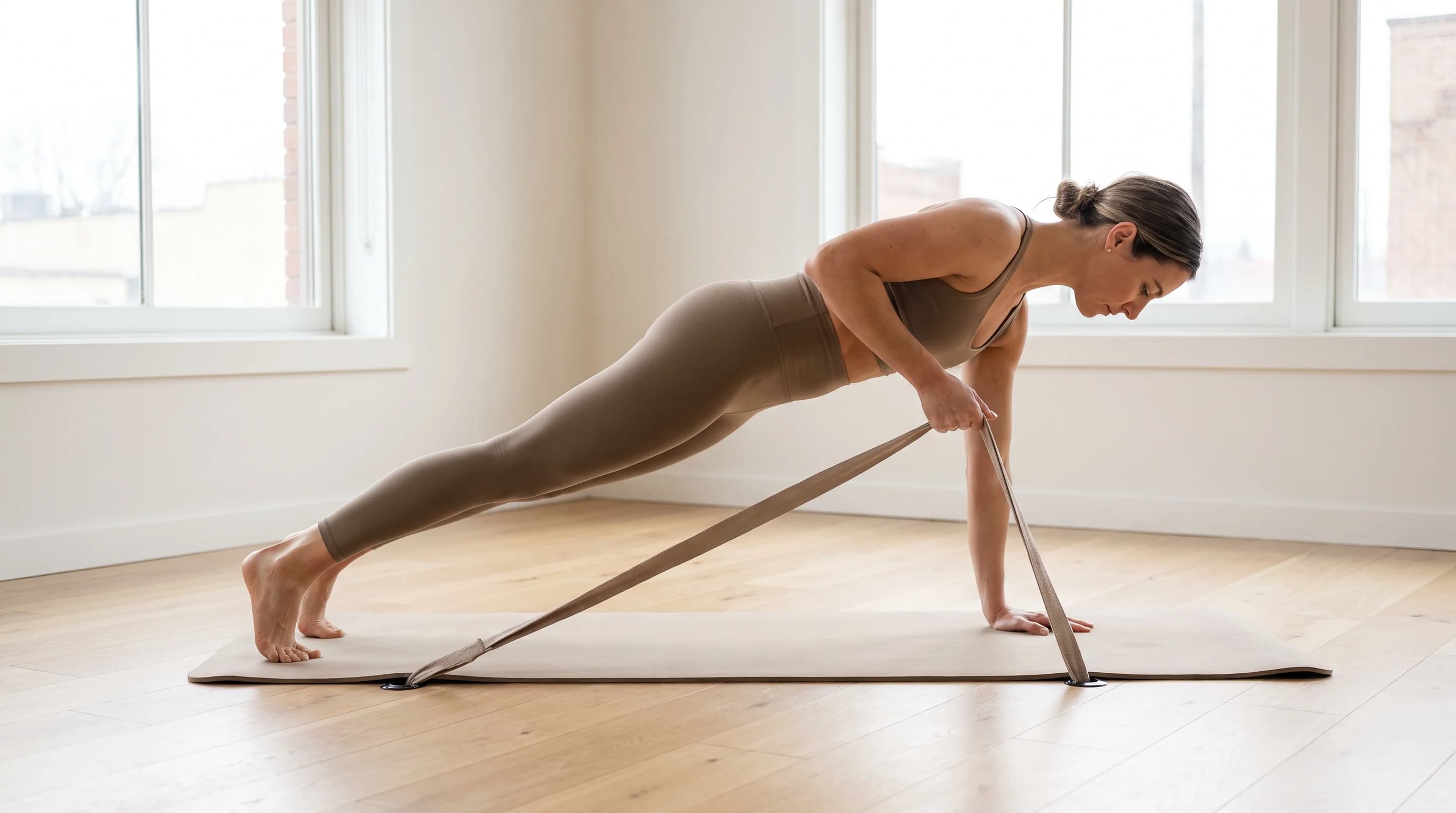
Plank row on the mat with a resistance band anchored under the hands for upper-back strength and trunk stability.
Setup instructions
Begin in a high plank on the mat with the wrists under the shoulders. Loop a resistance band around both palms or anchor it under the hands with one end held in each hand. Place the feet hip-width apart with the body in one organised line. Engage the core and press firmly through the supporting hand before rowing.
Breathing cues
Exhale to row. Inhale to return.
Movement steps
- 1Inhale to prepare in the plank position.
- 2Exhale to row one elbow back toward the rib cage against band tension.
- 3Keep the hips level and the trunk stable throughout the pull.
- 4Inhale to return the arm to the plank with control.
- 5Exhale to row the opposite arm, alternating evenly.
Common mistakes
Rotating the hips to gain row height; letting the hips sag or pike; using a band that is too strong; collapsing through the supporting shoulder; holding the breath.
Safety notes
Master a stable high plank before adding the row. Stop if wrist, shoulder, or sharp back discomfort appears.
Connections
Muscles worked
Goals supported
Equipment needed
Related exercises
FAQs
Is Resistance Band Plank Row suitable for beginners?
No. It is an advanced exercise combining plank stability with a single-arm row. Master a stable high plank before adding the pull.
What muscles does Resistance Band Plank Row work?
The upper back drives the row while the deep core and shoulders maintain plank stability throughout the alternating pull.
What is Resistance Band Plank Row good for?
It builds upper-back strength and trunk stability in one pattern before reformer plank and strap pulling work.
How is Resistance Band Plank Row different from Resistance Band Seated Row?
Plank row demands anti-extension core bracing in a high plank, while seated row is performed sitting with the band anchored at the feet.
Plan your class
Turn saved exercises into a class plan
Save exercises from the library, then build a reformer class plan with cues, timings, reps, and teaching notes.