Exercise
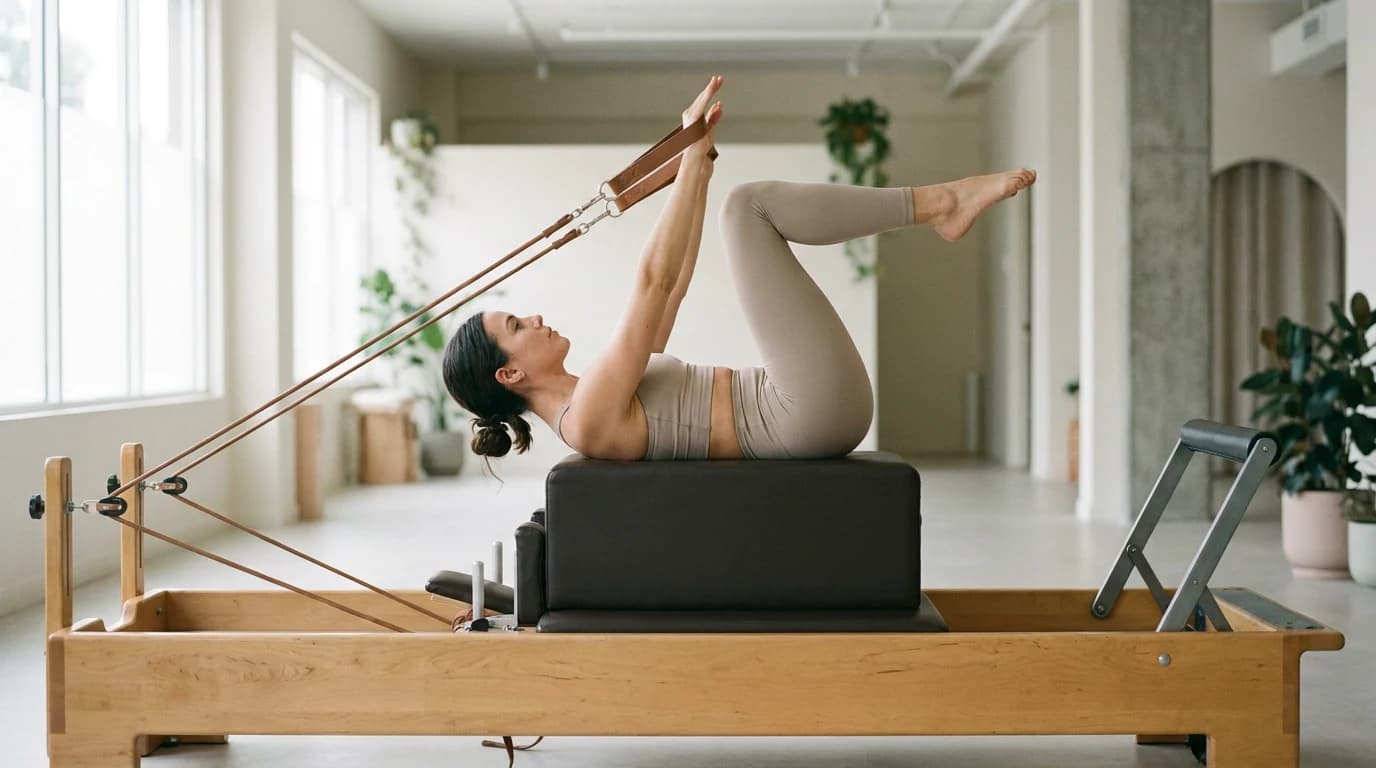
Supine long-box core sequence that coordinates arm circles and leg extension for trunk control and rhythm.
Setup instructions
Place the long box on the reformer and sit near the front edge before rolling down to lie supine with the head supported by the box. Hold one strap in each hand with the elbows bent and knees drawn in to tabletop. Choose light to moderate springs so the sequence stays smooth and controlled. Keep the ribs connected and the pelvis neutral.
Breathing cues
Exhale on the reach. Inhale through the arm circle. Exhale to return to the start.
Movement steps
- 1Start in a compact position with knees bent and hands near the shoulders.
- 2Exhale as the arms and legs reach away together on a diagonal.
- 3Inhale to circle the arms wide and then toward the hips while maintaining trunk stability.
- 4Exhale to bend the knees and return the hands to the start position.
- 5Repeat slowly before increasing flow.
Common mistakes
Flaring the ribs; pulling from the neck; extending the legs too low; rushing the arm circle and losing carriage control.
Safety notes
Keep the legs higher if the lower back lifts or strains. Stop if neck discomfort or shoulder pain appears during the sequence.
Connections
Muscles worked
Goals supported
Related exercises
FAQs
is Backstroke suitable for beginners?
Backstroke is usually taught at an intermediate level because it combines strap control with core sequencing on the long box. Beginners often prepare with simpler supine strap work first.
what muscles does Backstroke work?
Backstroke emphasises the deep core, hip flexors, and shoulder stabilisers that control the arm circles and leg reach.
what is Backstroke good for?
It is useful for building breath-linked coordination and core endurance while keeping the shoulders organised under strap tension.
Plan your class
Turn saved exercises into a class plan
Save exercises from the library, then build a reformer class plan with cues, timings, reps, and teaching notes.