Exercise
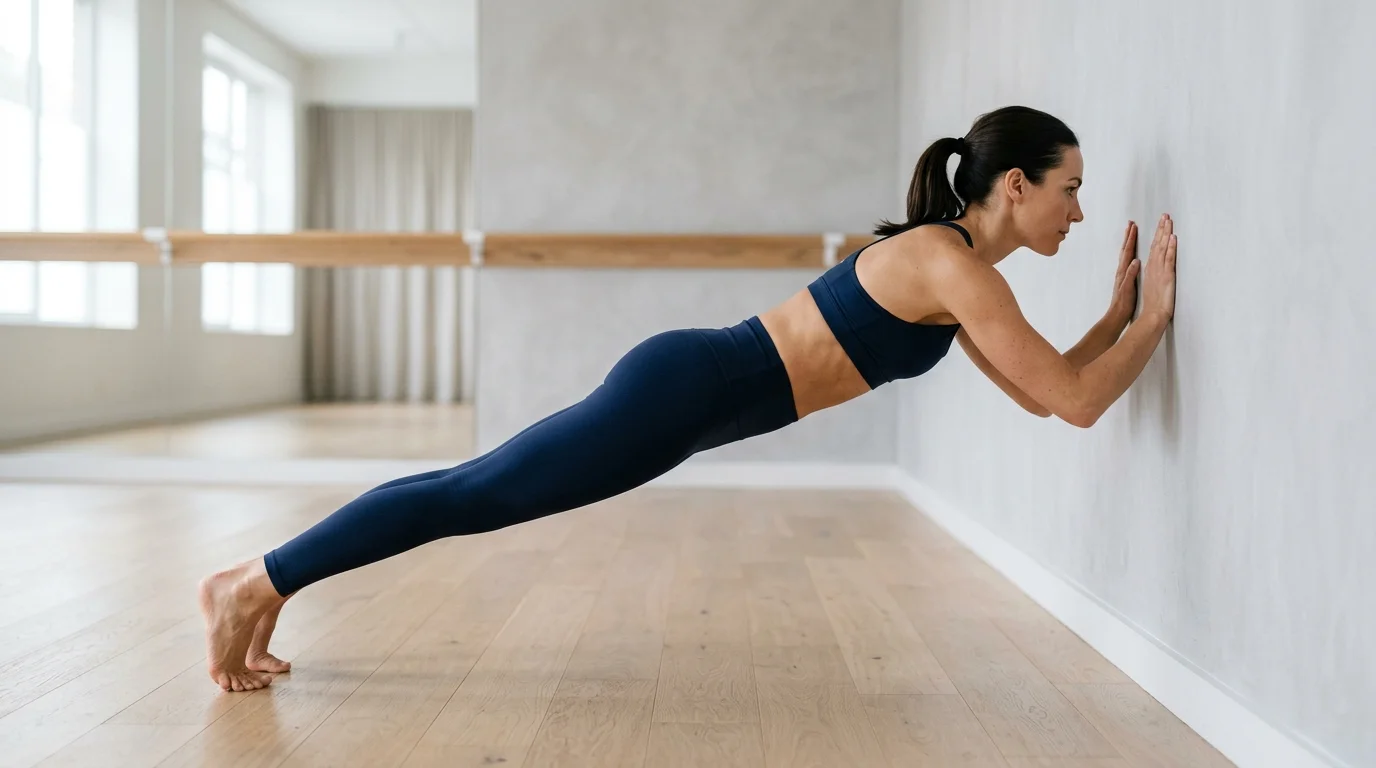
Incline plank hold with the hands on a studio wall for core endurance and shoulder organisation.
Setup instructions
Stand facing a studio wall at arm's length. Place the hands on the wall slightly wider than shoulder width at chest height. Walk the feet back until the body forms one long line from head to heels. Engage the core and keep the legs active.
Breathing cues
Breathe steadily throughout the hold.
Movement steps
- 1Inhale to prepare in the incline plank position.
- 2Exhale to press the hands into the wall and lengthen through the crown of the head.
- 3Hold the position with the ribs knitted and the hips level.
- 4Breathe steadily for several counts.
- 5Release with control when the hold ends.
Common mistakes
Letting the hips sag; hiking the shoulders to the ears; locking the elbows; standing too close and reducing trunk challenge; holding the breath.
Safety notes
Choose a foot position that keeps the trunk stable. Stop if wrist, shoulder, or neck discomfort appears.
Connections
Muscles worked
Goals supported
Equipment needed
Related exercises
FAQs
Is Wall Plank suitable for beginners?
Yes. The incline reduces load compared with a floor plank while still training trunk bracing and shoulder organisation. Foot position can scale difficulty.
What muscles does Wall Plank work?
The deep core stabilisers maintain the long body line. The shoulders and upper-back muscles support the arm position against the wall.
What is Wall Plank good for?
It builds core endurance and shoulder stability, making it a useful progression toward floor planks and reformer long stretch patterns.
How is Wall Plank different from Wall Push-Up?
Wall Plank is an isometric hold at a fixed angle, while Wall Push-Up adds repeated bending and straightening of the arms. Both use the same incline setup but train endurance versus pushing strength.
Plan your class
Turn saved exercises into a class plan
Save exercises from the library, then build a reformer class plan with cues, timings, reps, and teaching notes.