Exercise
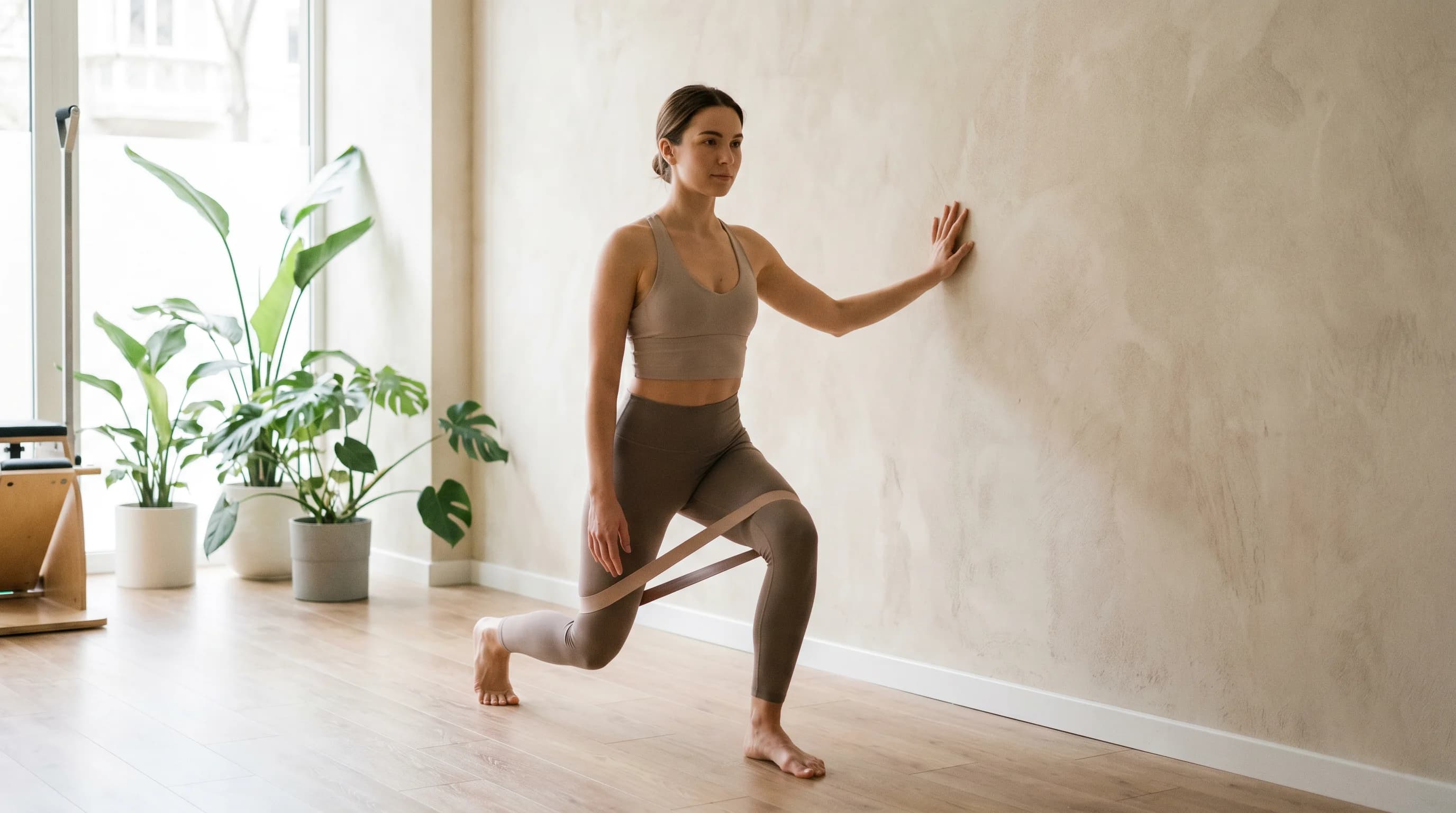
Supported lunge with one hand on a studio wall and a resistance band under the front foot for balance and loading.
Setup instructions
Stand sideways to a studio wall within easy reach. Place the hand closest to the wall on it at shoulder height for balance. Stand on the centre of a resistance band with the front foot and hold one end in each hand at chest height. Step the back foot into a lunge with the heel lifted and the hips square.
Breathing cues
Exhale to lower. Inhale to hold. Exhale to rise.
Movement steps
- 1Inhale to prepare in the lunge position.
- 2Exhale to bend both knees and lower into a comfortable lunge depth against band tension.
- 3Keep the front knee aligned over the ankle and the back knee pointing down.
- 4Inhale to hold briefly at the bottom.
- 5Exhale to press through the front foot and return to standing before switching sides.
Common mistakes
Letting the front knee collapse inward; leaning heavily on the wall; using band tension that pulls the trunk off balance; arching the low back; holding the breath.
Safety notes
Keep the lunge depth modest at first. Stop if knee pain, hip pinching, or balance loss occurs.
Connections
Muscles worked
Goals supported
Equipment needed
Related exercises
FAQs
Is Wall Resistance Band Lunge suitable for beginners?
It is best treated as an intermediate progression. Clients should be comfortable with a basic wall lunge before adding band loading under the front foot.
What muscles does Wall Resistance Band Lunge work?
The quadriceps and glutes of the front leg drive the lunge while the hip flexors of the back leg lengthen and the core maintains upright posture against band tension.
What is Wall Resistance Band Lunge good for?
It builds lunge alignment and lower-body control with wall balance support and band feedback before reformer lunges and free-standing band work.
How is Wall Resistance Band Lunge different from Wall Lunge?
Wall Lunge uses hand support on the wall alone. This variation adds a resistance band under the front foot for loading through the lunge pattern.
Plan your class
Turn saved exercises into a class plan
Save exercises from the library, then build a reformer class plan with cues, timings, reps, and teaching notes.