Exercise
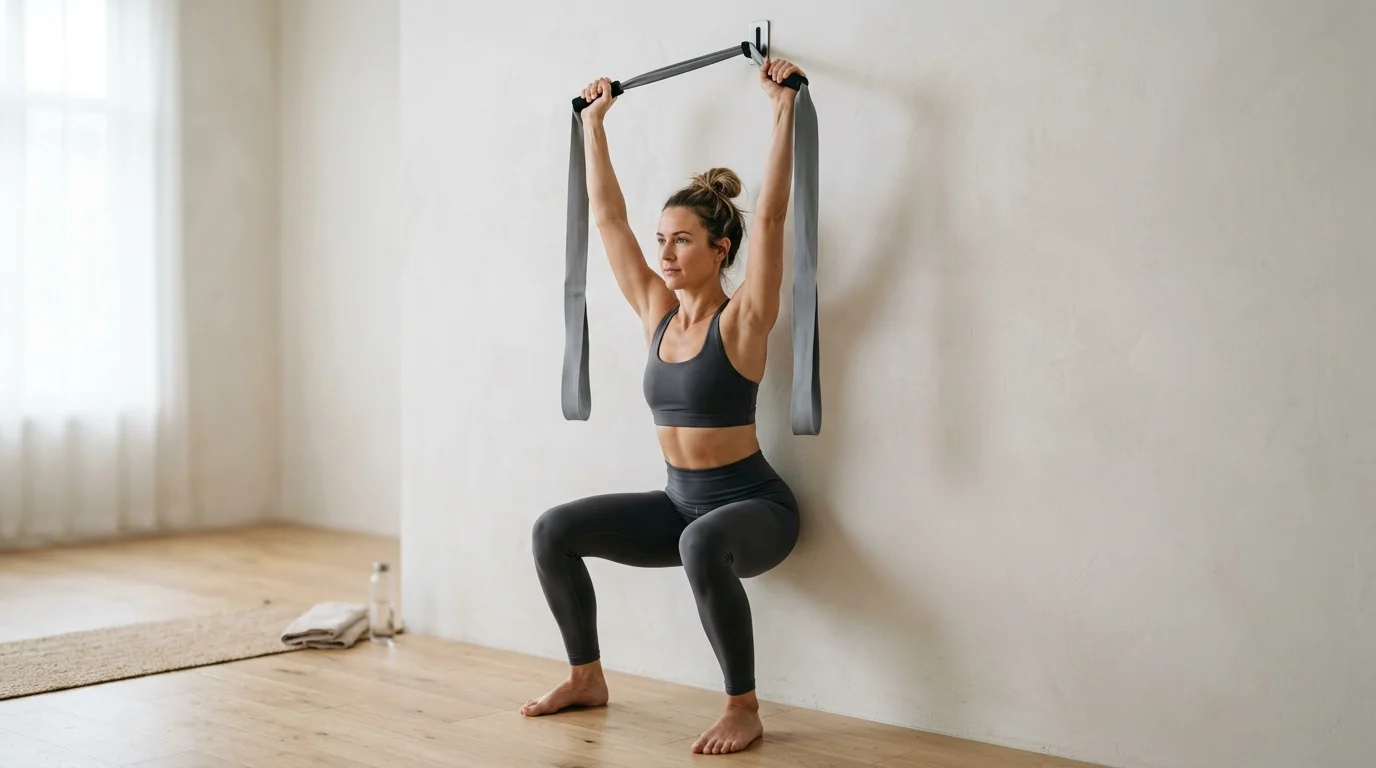
Wall-supported squat combined with an overhead band press for integrated lower- and upper-body control.
Setup instructions
Anchor a resistance band securely to a studio wall at a low or mid height. Stand with your back against the wall holding the band ends at shoulder height. Walk the feet forward into a wall squat position. Engage the core and keep the band lightly tensioned before moving.
Breathing cues
Exhale to squat and press. Inhale to hold. Exhale to rise.
Movement steps
- 1Inhale to prepare in the wall squat start position.
- 2Exhale to slide down the wall into a comfortable squat depth.
- 3Press the band overhead as the squat deepens, keeping the trunk supported on the wall.
- 4Inhale to hold briefly at the bottom.
- 5Exhale to press through the feet and slide up while lowering the arms with control.
Common mistakes
Letting the knees collapse inward; overarching the low back off the wall; using band tension that pulls the arms out of alignment; holding the breath; sliding too low before control is ready.
Safety notes
Keep squat depth modest and band tension manageable. Stop if knee pain, shoulder pinching, or dizziness occurs.
Connections
Muscles worked
Goals supported
Equipment needed
Related exercises
FAQs
Is Wall Resistance Band Squat Press suitable for beginners?
It is an intermediate full-body drill. Clients should be comfortable with wall squats and basic band pressing before combining both movements.
What muscles does Wall Resistance Band Squat Press work?
The quadriceps and glutes drive the squat while the shoulders press the band overhead. The core links the lower and upper body throughout.
What is Wall Resistance Band Squat Press good for?
It integrates leg strength, trunk stability, and shoulder control in one coordinated pattern using wall and band feedback.
How does this differ from a standard Wall Squat?
Wall Squat focuses on lower-body alignment alone. Squat Press adds overhead band resistance, demanding more trunk and shoulder coordination at the same time.
Plan your class
Turn saved exercises into a class plan
Save exercises from the library, then build a reformer class plan with cues, timings, reps, and teaching notes.