Exercise
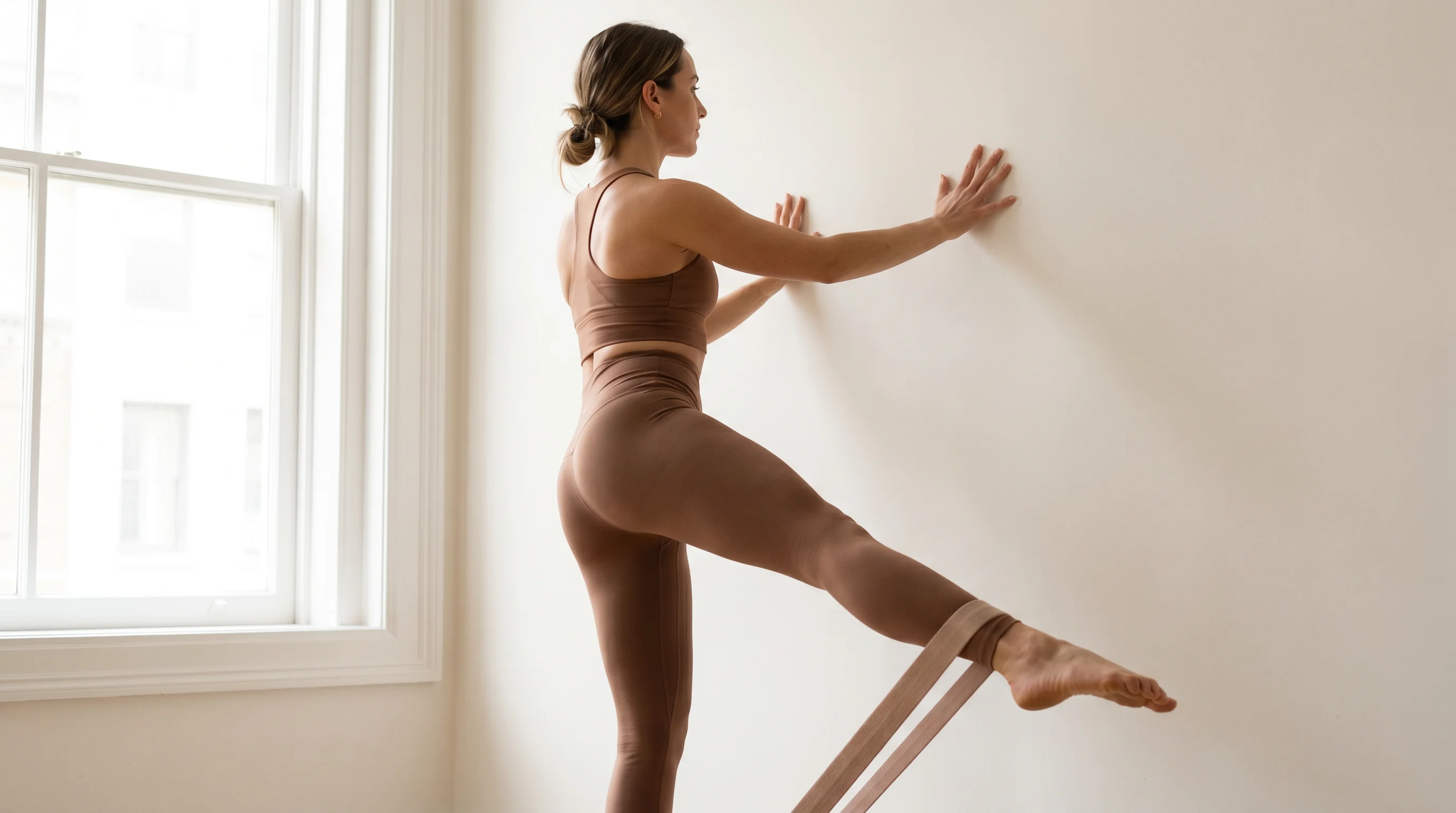
Wall Resistance Band Standing Leg Circles
IntermediateSaveSign in to save Wall Resistance Band Standing Leg CirclesStanding leg circles with wall support and a resistance band for hip mobility and lateral stability control.
Setup instructions
Stand sideways to a studio wall within easy reach. Place the hand closest to the wall on it at shoulder height for balance. Loop a resistance band around the ankles with light tension. Shift weight onto the leg closest to the wall with a soft knee.
Breathing cues
Exhale on the effort phase. Inhale between circles.
Movement steps
- 1Inhale to prepare on the supporting leg.
- 2Exhale to trace a small circle forward with the outside leg against band tension.
- 3Complete several circles in one direction with controlled tempo.
- 4Reverse the circle direction with equal range.
- 5Switch sides and repeat.
Common mistakes
Making circles too large and rocking the pelvis; leaning heavily on the wall; rotating the working foot outward; using a band that restricts smooth motion; holding the breath.
Safety notes
Keep the circles small until hip control feels clear. Stop if hip pinching or balance loss occurs.
Connections
Muscles worked
Goals supported
Equipment needed
Related exercises
FAQs
Is Wall Resistance Band Standing Leg Circles suitable for beginners?
It is best treated as an intermediate hip-control drill. Establish wall standing leg lift before adding band-resisted circles.
What muscles does Wall Resistance Band Standing Leg Circles work?
The glutes and hip stabilisers control the circular leg path against band tension while the core maintains a level pelvis with wall support.
What is Wall Resistance Band Standing Leg Circles good for?
It builds hip mobility and lateral stability before mat leg circles and reformer hip work.
How is it different from props Resistance Band Side Kick Circles?
This version is performed standing with wall support, while side kick circles are performed side lying on the mat.
Plan your class
Turn saved exercises into a class plan
Save exercises from the library, then build a reformer class plan with cues, timings, reps, and teaching notes.