Exercise
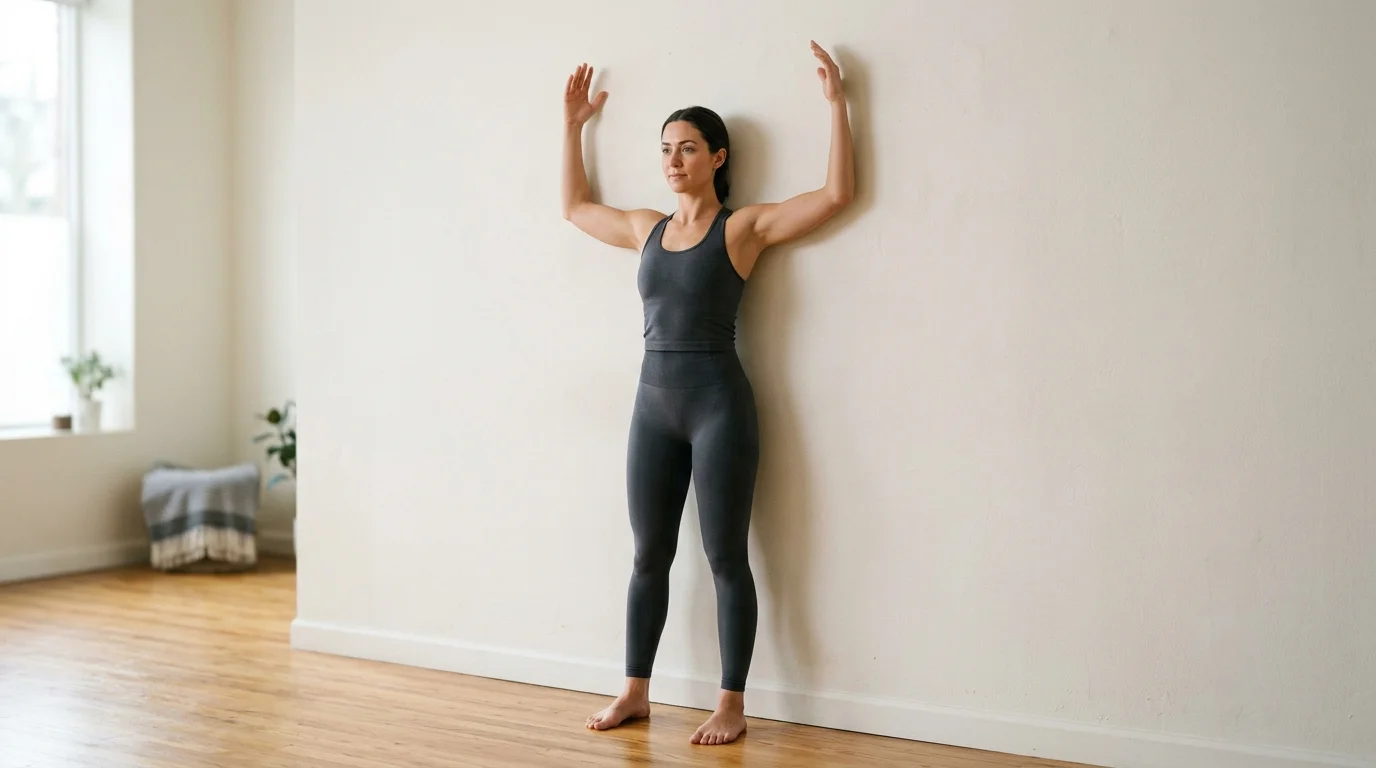
Standing wall snow angel slide for shoulder mobility, scapular control, and thoracic extension.
Setup instructions
Stand with your back, head, and pelvis against a studio wall. Place the feet hip-width apart a short distance from the wall. Reach the arms out to the sides at shoulder height with the backs of the hands toward the wall. Engage the core gently to keep the ribs from flaring.
Breathing cues
Exhale to slide up. Inhale to slide down.
Movement steps
- 1Inhale to prepare with the arms at shoulder height.
- 2Exhale to slide the arms overhead along the wall in a smooth arc.
- 3Pause briefly at the top without shrugging.
- 4Inhale to trace the arms back down to the start.
- 5Repeat with even tempo and relaxed shoulders.
Common mistakes
Arching the low back off the wall; shrugging the shoulders; forcing overhead range when the arms lose wall contact; holding the breath; rushing the arc.
Safety notes
Keep the range where the trunk stays supported on the wall. Stop if shoulder pinching or neck tension appears.
Connections
Muscles worked
Goals supported
Equipment needed
Related exercises
FAQs
Is Wall Snow Angels suitable for beginners?
Yes. The snow-angel arc is slow and supported by the wall. Range can stay modest until shoulder mobility improves.
What muscles does Wall Snow Angels work?
The shoulders and upper-back muscles trace the arm arc while the core maintains trunk contact with the wall.
What is Wall Snow Angels good for?
It builds shoulder mobility and scapular coordination, complementing wall angels and shoulder slides before reformer strap work.
How is Wall Snow Angels different from Wall Angels?
Wall Snow Angels trace a wider arc from shoulder height to overhead, while Wall Angels keep the elbows bent at 90 degrees throughout. Both train shoulder mobility with wall support.
Plan your class
Turn saved exercises into a class plan
Save exercises from the library, then build a reformer class plan with cues, timings, reps, and teaching notes.