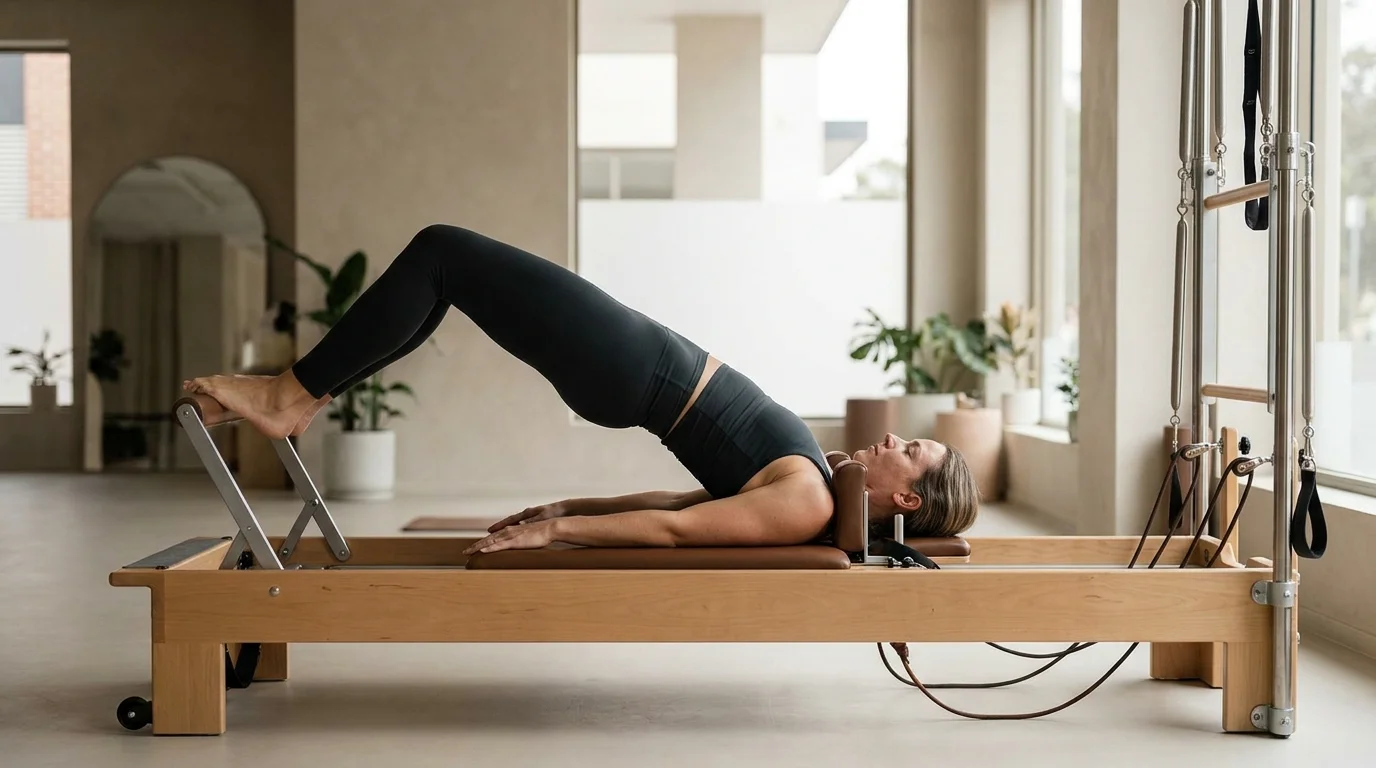
Exercise
Supine reformer arc linking spinal articulation with hip extension for full posterior-chain and core integration.
Setup instructions
Lie supine with feet on the footbar in a bridge preparation stance. Rest the shoulders against the shoulder blocks with arms by the sides. Find neutral pelvis before beginning.
Breathing cues
Coordinate breath with spinal direction. Exhale on articulation and exertion.
Movement steps
- 1Press the carriage out and lower the hips into a suspended bridge position.
- 2Inhale to roll the spine down toward the carriage as it moves in.
- 3Exhale to press out again and articulate the spine back up to bridge.
- 4Then reverse: lower the spine first, press the carriage out, and lift the hips to bridge.
- 5Repeat in both directions with smooth breath coordination.
Common mistakes
Dropping the hips too fast; losing shoulder block contact; failing to articulate through the spine; rushing the arc.
Safety notes
Use lighter springs when learning. Requires clear spinal articulation. Stop if shoulder block discomfort appears.
Connections
Muscles worked
Goals supported
Related exercises
FAQs
Is Semi-Circle suitable for beginners?
Semi-Circle is an intermediate exercise that requires clear spinal articulation and comfortable shoulder block positioning. Beginners should first establish Short Spine Massage and reliable bridging before attempting it.
What muscles does Semi-Circle work?
Semi-Circle primarily works the glutes and hamstrings through the bridge position. The core and upper back support the spinal articulation, and the legs drive through the footbar.
What is Semi-Circle good for?
Semi-Circle develops spinal articulation, glute strength, and hip extension control. The arc shape trains the spine to move sequentially and builds posterior-chain strength through a dynamic range.
Why is Semi-Circle done in both directions?
Doing Semi-Circle in both directions ensures the spine articulates equally well going up and coming down. Each direction creates a subtly different load on the posterior chain and spinal segments.
Plan your class
Turn saved exercises into a class plan
Save exercises from the library, then build a reformer class plan with cues, timings, reps, and teaching notes.