Exercise
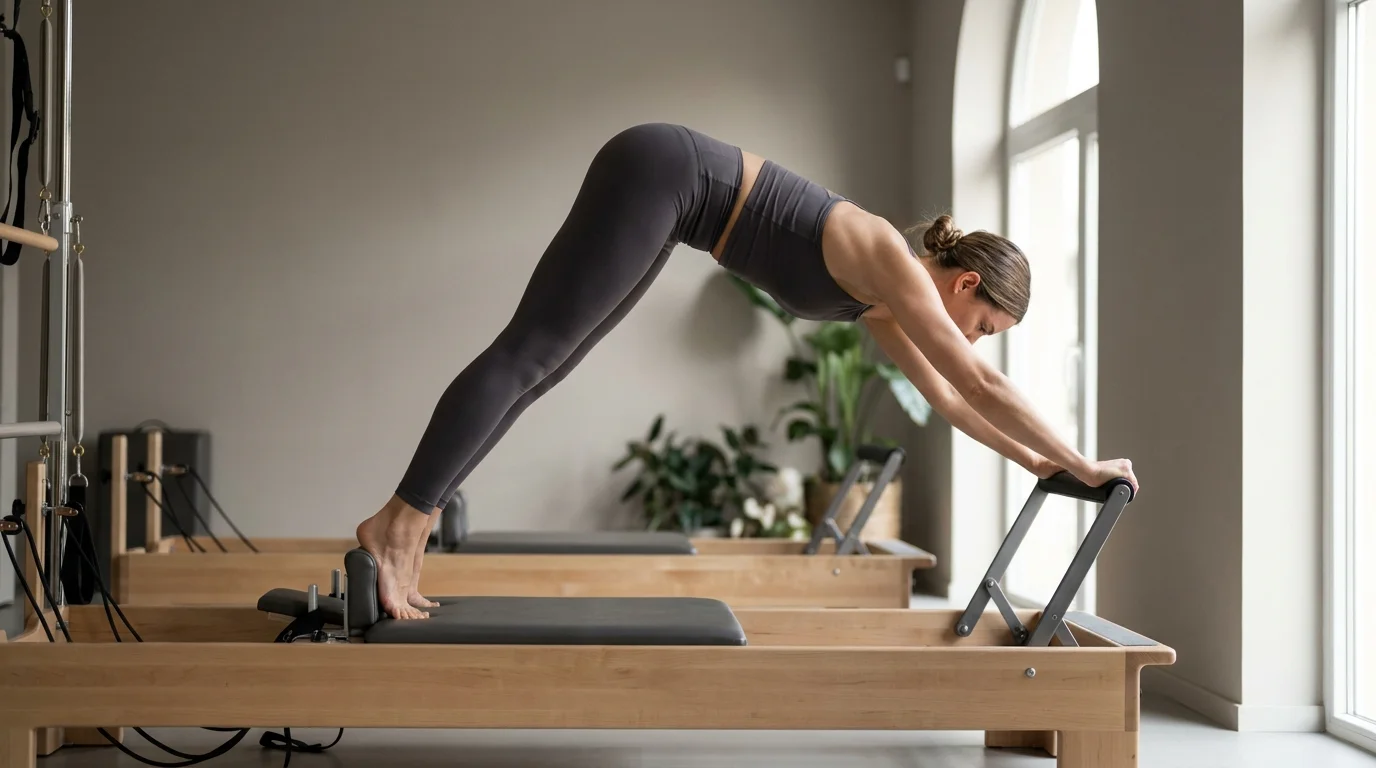
Pike-to-plank push-pull on the reformer that challenges hamstring length, shoulder stability, and core control.
Setup instructions
Place hands on the footbar and feet on the carriage, curling into a high pike position. Press the heels back and keep the arms straight. Find length through the spine in the starting pike.
Breathing cues
Inhale to extend to plank. Exhale to lift into pike.
Movement steps
- 1Inhale to push the carriage back and drop the hips into a plank line.
- 2Exhale to lift the hips and pike the carriage back in.
- 3Keep the knees straight and the arms steady through the transition.
- 4Repeat with control.
Common mistakes
Bending the knees in the pike; locking the elbows in the plank; rushing the transition; losing shoulder stability.
Safety notes
Requires hamstring flexibility and wrist stability. Avoid if shoulder or wrist issues are present.
Connections
Muscles worked
Goals supported
Related exercises
FAQs
Is Up Stretch suitable for beginners?
Up Stretch requires adequate hamstring flexibility and wrist stability. Beginners without these should first work on Elephant, Long Stretch, and Down Stretch before attempting Up Stretch.
What muscles does Up Stretch work?
Up Stretch challenges the core through the plank and pike transition. The hamstrings work to maintain the pike position and the upper back and shoulder stabilisers support the arms throughout.
What is Up Stretch good for?
Up Stretch develops hamstring length, shoulder endurance, and the ability to control the transition between plank and pike. It is a key exercise in the long stretch series.
How does Up Stretch differ from Down Stretch?
Down Stretch uses a kneeling arc position; Up Stretch uses a standing pike with feet on the carriage. Up Stretch demands more hamstring flexibility and creates a different spinal and hip challenge.
Plan your class
Turn saved exercises into a class plan
Save exercises from the library, then build a reformer class plan with cues, timings, reps, and teaching notes.