Exercise
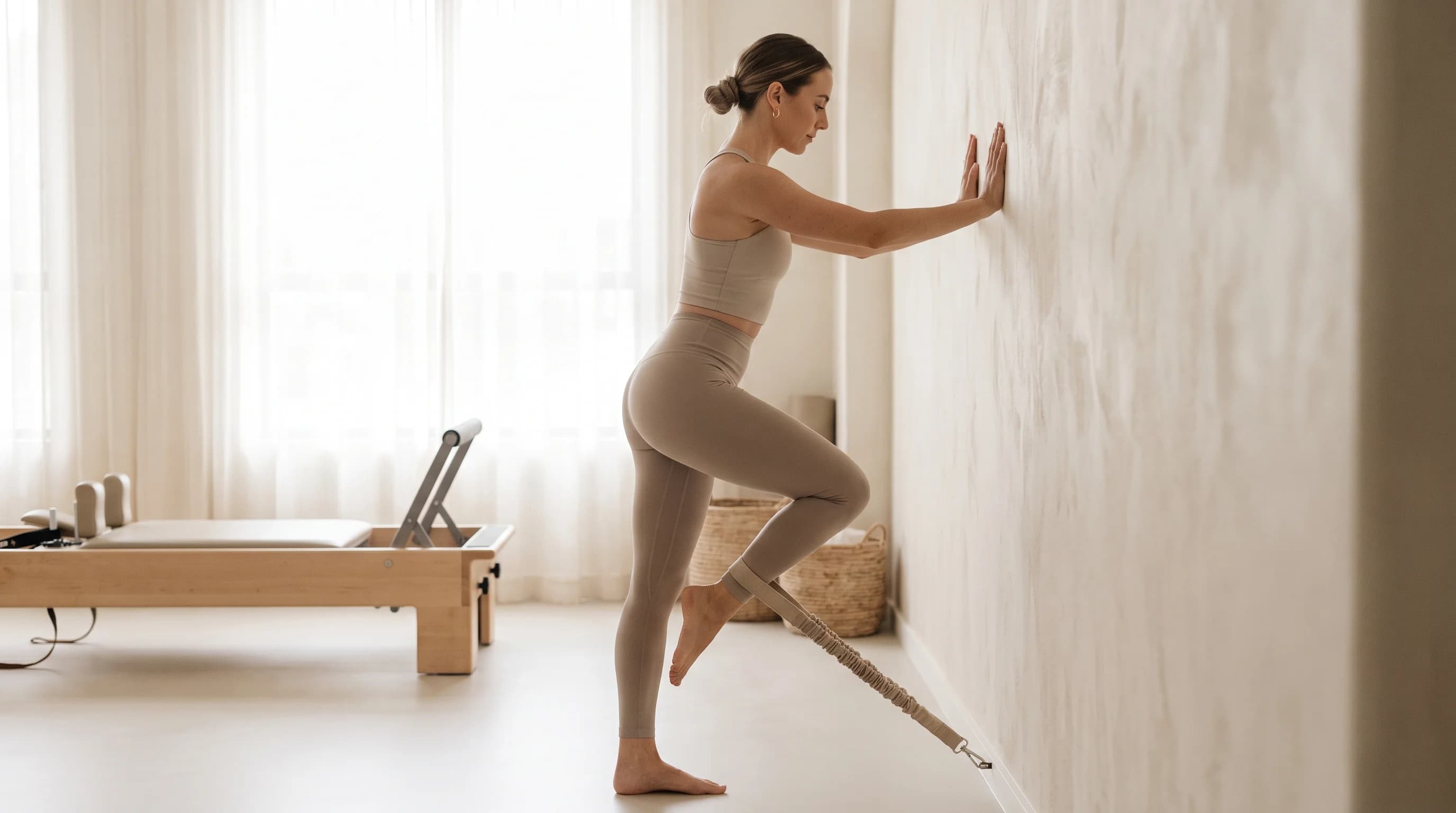
Standing hamstring curl with a resistance band anchored low on a studio wall for posterior-chain control.
Setup instructions
Anchor a resistance band securely to a studio wall at a low point near the floor. Stand facing the wall at arm's length with both hands placed lightly on it at shoulder height. Loop the free end of the band around one ankle with light tension. Stand on the opposite leg with a soft knee and the hips level.
Breathing cues
Exhale to curl. Inhale to extend.
Movement steps
- 1Inhale to prepare in standing.
- 2Exhale to bend the banded knee and curl the heel toward the glute against resistance.
- 3Keep the thighs close together and the trunk upright.
- 4Inhale to extend the leg back to the start with control.
- 5Complete one side before switching the band to the opposite ankle.
Common mistakes
Swinging the leg for momentum; arching the low back to gain curl height; letting the standing knee lock; using a band that is too strong; holding the breath.
Safety notes
Choose a band that allows a full curl with control. Stop if knee pain, hamstring cramping, or sharp back discomfort appears.
Connections
Muscles worked
Goals supported
Equipment needed
Related exercises
FAQs
Is Wall Resistance Band Hamstring Curl suitable for beginners?
Yes. The wall provides balance support and the low anchor keeps setup consistent. Choose a band that allows a full curl with control.
What muscles does Wall Resistance Band Hamstring Curl work?
The hamstrings drive the knee flexion while the glutes and deep core maintain upright posture throughout the curl.
What is Wall Resistance Band Hamstring Curl good for?
It builds accessible hamstring strength in standing before supine wall hamstring curls, reformer footwork, and chair hamstring work.
How is Wall Resistance Band Hamstring Curl different from Wall Hamstring Curl?
Wall Hamstring Curl is performed supine with the feet on the wall. This standing variation uses a low-anchored band around the ankle for resisted knee flexion.
Plan your class
Turn saved exercises into a class plan
Save exercises from the library, then build a reformer class plan with cues, timings, reps, and teaching notes.