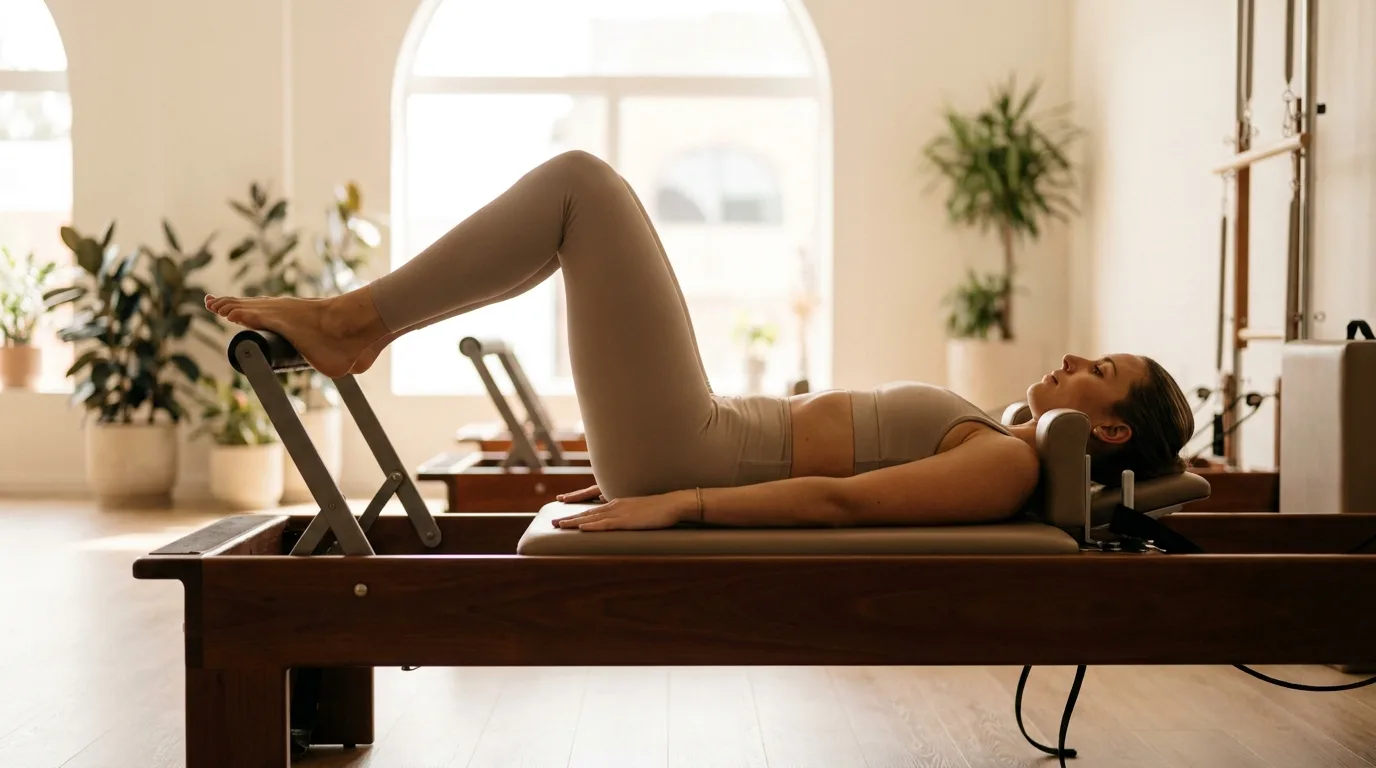
Exercise
Foundational leg press variations to build lower-body alignment and control.
Setup instructions
Lie supine on the carriage with headrest as appropriate. Place feet on the footbar in parallel stance.
Breathing cues
Inhale to prepare. Exhale as you press out. Inhale to return.
Movement steps
- 1Press carriage out with control, then return without dropping springs.
- 2Repeat through heel, toe, and wide-stance variations.
Common mistakes
Locking knees at full extension; gripping hip flexors; rushing return phase.
Safety notes
Keep motion pain-free and avoid hyperextending knees.
Focus Areas & Conditions
Tight Hips
Suitability: Foundational footwork in parallel can help some people warm the hips and hamstrings with predictable spring feedback before deeper ranges.
Caution: Keep knees tracking over second toes and avoid forcing the carriage out if you feel pinching at the front of the hip. Use lighter springs when learning.
Lower Back Discomfort
Suitability: Foundational footwork can help some people find neutral pelvis and even leg alignment before more demanding core patterns.
Caution: Avoid overarching the lower back at the end of the press. Use lighter springs and focus on steady trunk position.
Weak Glutes
Suitability: Foundational bilateral leg press that can help some people feel glute and hamstring engagement with spring feedback.
Caution: Avoid locking the knees at full extension. Use lighter springs until you can press without gripping the hip flexors or tucking the pelvis.
Variations
- harder: Scooter - Progress from bilateral footwork to unilateral hip stability.
- alternative: Footwork on Chair - Chair footwork as upright leg-press alternative.
Connections
Muscles worked
Goals supported
Related exercises
FAQs
How many reps should beginners do for footwork?
A common starting point is 8 to 12 controlled reps per stance. Prioritize smooth carriage return and knee tracking over volume.
Plan your class
Turn saved exercises into a class plan
Save exercises from the library, then build a reformer class plan with cues, timings, reps, and teaching notes.