Guide · Beginner reformer Pilates
How to Choose Beginner-Friendly Reformer Exercises
Beginner-friendly reformer exercises are not just the easiest-looking exercises. A good starting exercise should help you understand the reformer, control the carriage, recognise useful instructor cues, and build conf…
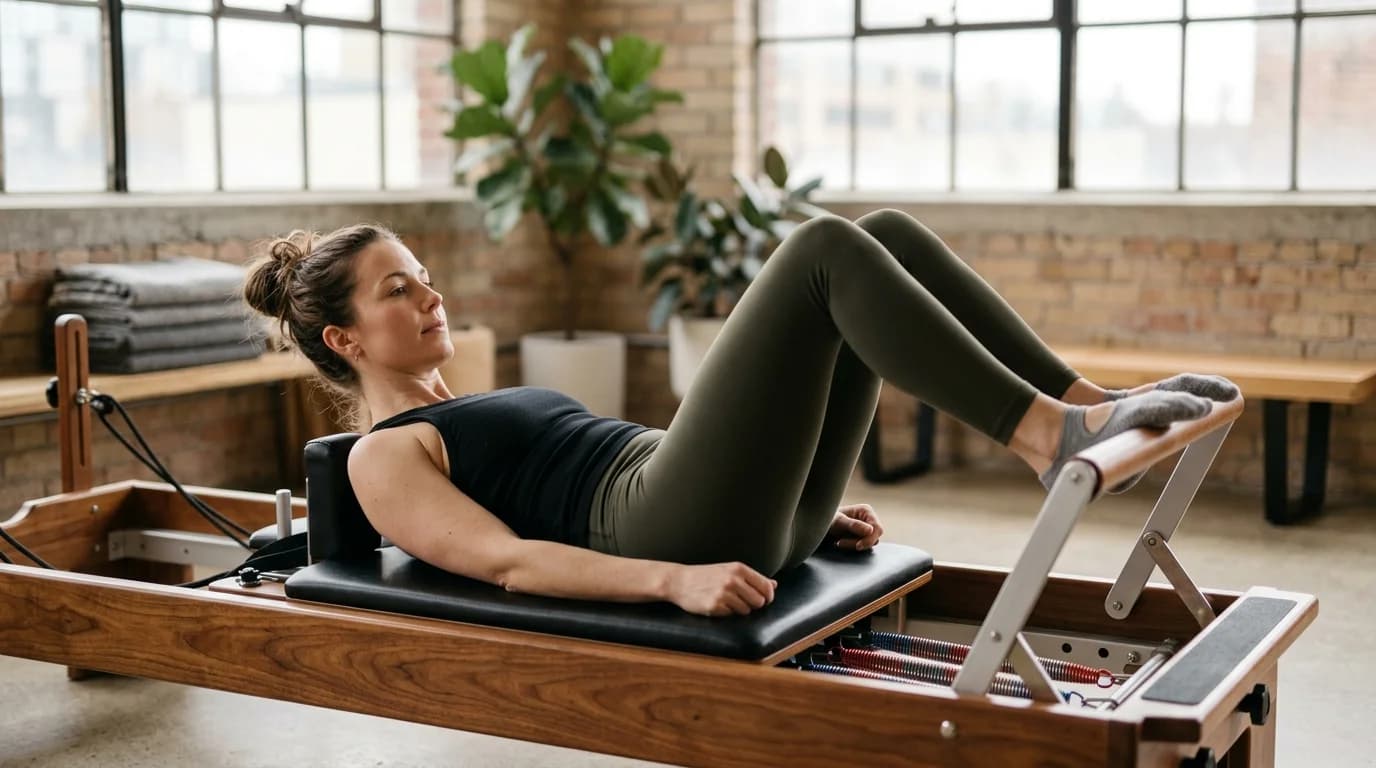
This guide is for educational discovery only. If you have pain, an injury, pregnancy, postnatal considerations, or a specific medical concern, speak to a qualified Pilates instructor or appropriate healthcare professional before trying new exercises.
Quick Answer
A beginner-friendly reformer exercise usually has a clear setup, a supported body position, a manageable range of movement, and enough feedback from the reformer, footbar, straps, or springs to help the user understand what is happening. Good starting examples include Footwork Series, Bridging on Reformer, Hundred Prep, Frog in Straps, and Mermaid Stretch.
What Makes An Exercise Beginner-Friendly?
A beginner-friendly exercise should give the user a clear way to learn. It should not rely on complex transitions, extreme range, fast coordination, or unstable positions before the user understands the equipment.
The best beginner exercises usually teach one or two important ideas at a time. For example, Footwork Series helps users understand the footbar, carriage movement, and lower-body alignment. Frog in Straps introduces strap work and hip movement while the body remains supported.
Beginner-friendly does not always mean easy. Some beginner exercises can feel demanding because they require patience, breath control, and body awareness. The key difference is that the user can understand the task and receive useful feedback from the equipment.
A useful beginner exercise should help the user answer questions such as:
- Where should I be positioned?
- What part of the equipment am I using?
- How should the carriage move?
- What should I feel working?
- How do I know if I am losing control?
- How could this exercise progress later?
The Beginner-Friendly Checklist
Use this checklist when choosing reformer exercises to explore.
1. The setup is clear
A beginner exercise should have a setup that can be explained simply. If the exercise requires several equipment changes, unusual body positions, or fast transitions, it may be better saved for later.
Good examples:
2. The body position is supported
Many beginner exercises use lying, seated, or stable positions so the user can focus on control rather than balance alone.
Good examples:
3. The movement pattern is understandable
The exercise should make sense to the user. Pressing the carriage out and returning it, lifting and lowering with control, or moving the legs in straps can be easier to understand than complex choreography.
Good examples:
4. The equipment gives useful feedback
The carriage, springs, straps, and footbar should help the user notice control. If the carriage bangs, the straps pull unevenly, or the user loses position, the equipment is giving feedback that something needs adjusting.
Useful equipment pages:
5. The range can be reduced
A beginner-friendly exercise should allow a smaller range of movement. This helps users build control before trying a larger or more demanding version.
6. There is a clear reason to do it
Each exercise should connect to a useful beginner goal, such as core strength, posture support, hip mobility, or equipment confidence.
Good Starting Exercises To Explore
Footwork Series
- Why it is beginner-friendly: The footbar gives a clear point of contact, and the carriage gives immediate feedback as it moves.
- Good for: foot placement, lower-body alignment, spring feedback, carriage control
- Equipment: Reformer, footbar
- View exercise: Footwork Series
Bridging On Reformer
- Why it is beginner-friendly: The body is supported while the user explores glute, hamstring, and trunk control.
- Good for: pelvic awareness, posterior-chain control, slow movement
- Equipment: Reformer
- View exercise: Bridging on Reformer
Hundred Prep
- Why it is beginner-friendly: It introduces breath rhythm and core control before more demanding versions of the Hundred.
- Good for: beginner core awareness, breathing, trunk control
- Equipment: Reformer
- View exercise: Hundred Prep
Frog In Straps
- Why it is beginner-friendly: It introduces strap work in a supported position and helps users explore controlled hip movement.
- Good for: strap awareness, hip control, pelvis and trunk organisation
- Equipment: Reformer, straps
- View exercise: Frog in Straps
Mermaid Stretch
- Why it is beginner-friendly: It can introduce breath-led movement and side-body mobility without requiring complex reformer coordination.
- Good for: mobility, posture awareness, breathing, spinal movement
- Equipment: Reformer
- View exercise: Mermaid Stretch
Kneeling Arm Press With Pilates Ring
- Why it is beginner-friendly: The ring can provide feedback for shoulder organisation and trunk support.
- Good for: shoulder control, upright posture, upper-back awareness
- Equipment: Reformer, Pilates ring
- View exercise: Kneeling Arm Press with Pilates Ring
How To Choose By Goal
If your goal is core strength
Choose exercises that teach breathing, trunk control, and pelvic awareness before harder core progressions.
Useful pages:
If your goal is posture support
Choose exercises that help you notice shoulder organisation, upper-back involvement, breath, and upright control.
Useful pages:
If your goal is hip mobility
Choose exercises where the legs can move with control while the pelvis and trunk remain organised.
Useful pages:
If your goal is equipment confidence
Start with exercises that introduce one main equipment feature at a time.
Useful pages:
How Equipment Changes The Choice
Footbar exercises can feel clearer at first
The footbar gives a stable contact point. This is why exercises such as Footwork Series are often useful early in a beginner journey.
Strap exercises require control even when supported
Straps can support arm or leg movement, but they also require awareness. If the straps pull unevenly or the movement feels uncontrolled, the user may need a smaller range, different spring setting, or clearer cue.
Props can provide feedback
Accessories such as the Pilates ring can help the user feel pressure, alignment, or shoulder organisation. They are not just there to make the exercise harder.
More equipment is not always better
Beginners usually benefit from learning one equipment idea at a time. A simple footbar exercise may be more useful than a more complicated exercise using multiple props.
Signs An Exercise May Be Too Advanced For Now
An exercise may not be the best beginner choice if:
- the setup is confusing before the movement begins
- the carriage moves too quickly or feels hard to control
- the user cannot follow the breathing or movement pattern
- the range feels too large to manage
- the exercise relies on balance before basic control is established
- the user feels unsafe, unstable, or unsure what to do
- the spring setting cannot be understood without repeated correction
- the user is copying the shape without understanding the purpose
This does not mean the exercise is bad. It may simply be better as a later progression.
Useful next step: Reformer Pilates Exercise Progressions
How To Progress Sensibly
A sensible progression does not always mean choosing a harder-looking exercise. It may mean improving control, reducing momentum, increasing range gradually, or learning a new equipment feature.
Progression might involve:
- moving more smoothly
- controlling the carriage more quietly
- increasing or reducing spring support
- using straps after learning footbar work
- increasing range only when control is maintained
- moving from supported positions to less supported positions
- adding coordination only after the base movement is understood
For example, a user might start with Footwork Series, then explore Bridging on Reformer, then Hundred Prep, and later Frog in Straps once they understand more about spring and carriage control.
Progression should be guided by quality, not just difficulty.
What To Ask An Instructor
Useful questions include:
- Is this exercise suitable for a beginner?
- What is the main thing this exercise is trying to teach?
- Which spring setting should I use?
- Is this spring setting supporting me or challenging me?
- What should I feel working?
- What should I do if the carriage moves too quickly?
- Can I use a smaller range of movement?
- What is an easier version of this exercise?
- What exercise should I learn before progressing to this one?
- How do I know when I am ready for a harder version?
If you are unsure, ask for a modification. Good beginner practice is not about pushing through confusion; it is about learning control.
FAQs
What makes a reformer Pilates exercise beginner-friendly?
A beginner-friendly exercise usually has a clear setup, a supported position, a manageable range of movement, and useful feedback from the reformer equipment. It should help the user understand control rather than overwhelm them with complex coordination.
Are beginner reformer exercises always easy?
No. Beginner exercises can still be challenging because they require control, breathing, patience, and awareness. Beginner-friendly means the task is understandable and suitable as a starting point, not that it requires no effort.
Should beginners start with footbar exercises?
Many beginners find footbar exercises easier to understand at first because the footbar gives a clear point of contact. Footwork Series is a useful example because it introduces carriage movement and spring feedback in a supported way.
Are strap exercises suitable for beginners?
Some strap exercises can be beginner-friendly when taught with appropriate setup and spring guidance. Frog in Straps is a useful starting point because the body is supported while the user learns how the straps affect leg movement and control.
How do I know if an exercise is too advanced?
An exercise may be too advanced for now if the setup feels confusing, the carriage feels hard to control, the movement pattern is unclear, or the user feels unsafe or unstable. An instructor can suggest an easier version or a better preparation exercise.
Should I choose exercises by goal or equipment?
Both can be useful. If you know your goal, start with pages such as core strength, posture support, or hip mobility. If you are new to the reformer, choosing by equipment can also help, such as starting with the footbar before exploring straps.
Can I build my own beginner plan from this page?
This page can help you understand sensible starting points, but it is not a personalised plan. A qualified Pilates instructor should help choose exercises, spring settings, modifications, and progressions for your level and circumstances.
Where should I go next?
Start with Beginner Reformer Pilates Exercises if you want a curated list of exercise pages. Read Reformer Pilates for Beginners if you want the wider overview, or use the Reformer Pilates Equipment Guide if you want to understand the machine first.