Guide · Core strength
Core Stability vs Core Strength in Pilates
Core stability and core strength are closely related, but they are not exactly the same thing. In Pilates, and especially on the reformer, users often need both: the ability to create useful support through the trunk,…
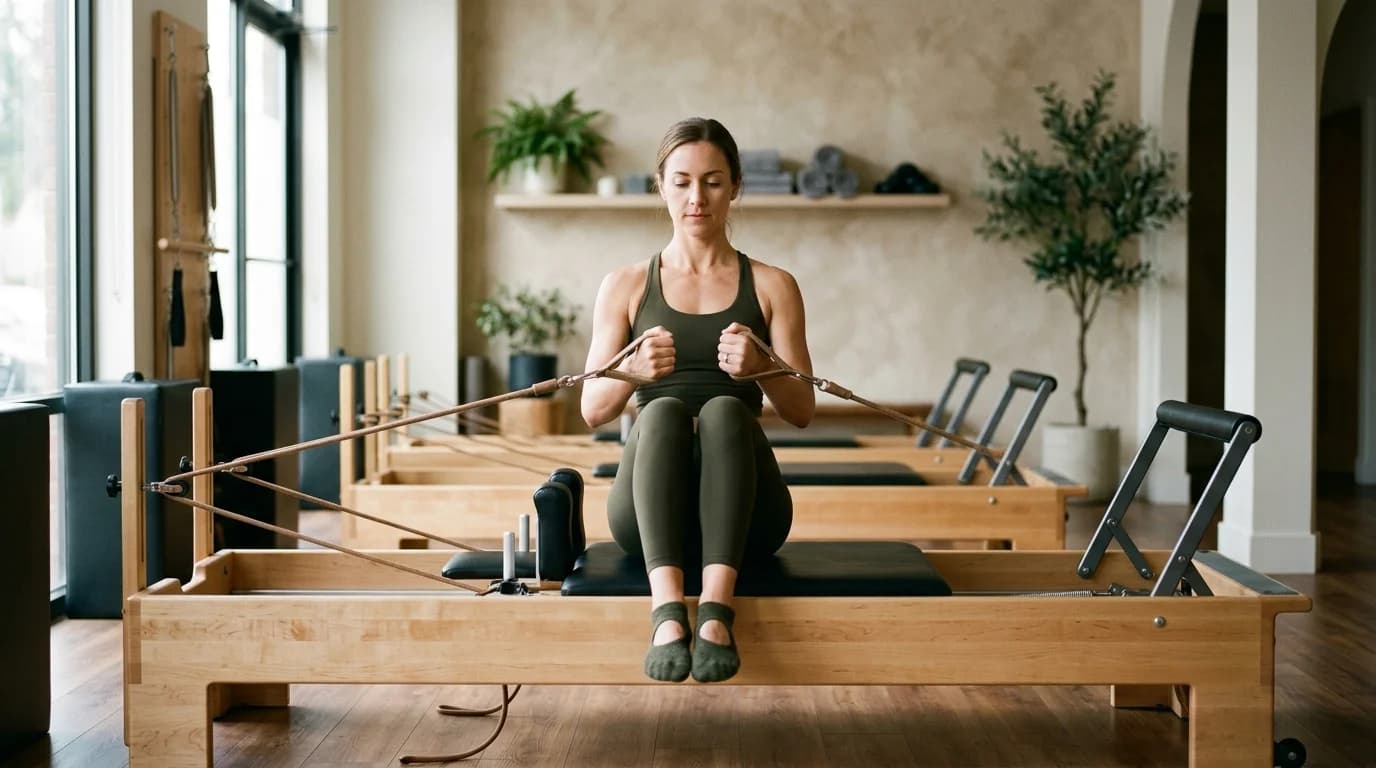
This guide is for educational discovery only. If you have pain, an injury, pregnancy, postnatal considerations, or a specific medical concern, speak to a qualified Pilates instructor or appropriate healthcare professional before trying new exercises.
Quick Answer
Core strength is the ability to create and manage useful force through the trunk. Core stability is the ability to stay organised and controlled while movement happens. In Pilates, the two often overlap. Exercises such as Hundred Prep, Frog in Straps, Bridging on Reformer, and Leg Circles in Straps can all involve both strength and stability depending on setup and cueing.
What Core Strength Means
Core strength is usually about the ability to create and manage force through the trunk. In Pilates, this does not mean simply tightening the stomach or forcing the body to hold a position.
Core strength may show up when the user can:
- maintain trunk support during movement
- coordinate breath and effort
- control the carriage against spring resistance
- support the pelvis while the legs move
- manage a larger range without losing organisation
- repeat a movement with quality rather than momentum
In reformer Pilates, Hundred Prep is a useful beginner example because it connects breath rhythm, trunk support, and abdominal endurance. Bridging on Reformer can also connect core strength with glutes, hamstrings, and pelvic control.
What Core Stability Means
Core stability is about staying organised while movement happens. It is less about how hard the user can brace and more about whether the trunk, pelvis, ribs, shoulders, and breath can remain coordinated.
Core stability may show up when the user can:
- keep the pelvis steady while the legs move
- control the straps without one side pulling unevenly
- keep the carriage moving smoothly
- reduce unnecessary rocking or shifting
- breathe without losing position
- adjust range when control is lost
In reformer Pilates, Frog in Straps is a useful example because the legs move while the pelvis and trunk need to stay organised. Leg Circles in Straps may demand more stability because the legs move through a larger circular path.
How They Overlap In Pilates
In real Pilates movement, core strength and core stability are rarely completely separate. A user may need strength to support the body and stability to maintain organisation while the movement changes.
For example:
- Hundred Prep may build strength through repeated breath and trunk work, but it also requires stability to maintain position.
- Frog in Straps may support stability through the pelvis and trunk, but it also requires strength to control the movement.
- Bridging on Reformer may involve core strength, glutes, and hamstrings while also asking for pelvic control.
- Footwork Series may look lower-body focused, but it still requires trunk support and carriage control.
This is why a good Pilates instructor may talk about control, support, breath, alignment, and movement quality rather than separating every exercise into one single category.
How The Reformer Changes The Picture
The reformer adds feedback through the moving carriage, springs, straps, and footbar. This feedback can make the difference between core strength and core stability easier to feel.
The carriage may show whether the user is controlling the movement smoothly. The springs may change how much support or resistance is present. The straps may reveal whether the pelvis, ribs, or shoulders are shifting. The footbar may give a stable contact point while the user learns to organise the trunk.
This means a reformer exercise can ask different questions depending on setup:
- Can the user create enough support to move with control?
- Can the user stay organised while the legs or arms move?
- Can the user return the carriage smoothly?
- Can the user breathe without losing position?
- Can the user reduce range when stability is lost?
The same exercise can therefore be strength-focused, stability-focused, or both depending on how it is taught.
Exercises That Show Core Strength
Hundred Prep
Hundred Prep is one of the clearest beginner-friendly core strength examples. It introduces breath rhythm, trunk support, and abdominal endurance without jumping straight into a more advanced version of the Hundred.
- Good for: breath, trunk support, beginner core awareness
- Equipment: Reformer
- View exercise: Hundred Prep
Bridging On Reformer
Bridging on Reformer can connect core strength with glutes, hamstrings, and pelvic control. It is useful because the body is supported, but the user still needs to organise the trunk and pelvis.
- Good for: pelvic control, glutes, hamstrings, trunk support
- Equipment: Reformer
- View exercise: Bridging on Reformer
Elephant
Elephant can be a more demanding example because it asks for trunk support, shoulder organisation, hamstring involvement, and carriage control from a less supported position.
- Good for: intermediate core control, carriage control, hamstring involvement
- Equipment: Reformer, footbar
- View exercise: Elephant
Exercises That Show Core Stability
Frog In Straps
Frog in Straps is a useful beginner example of core stability because the legs move while the pelvis and trunk need to stay organised.
- Good for: strap awareness, hip movement, pelvic organisation
- Equipment: Reformer, straps
- View exercise: Frog in Straps
Leg Circles In Straps
Leg Circles in Straps may require more control because the legs move through a larger changing path. The user needs to manage the straps, range, pelvis, and trunk organisation.
- Good for: strap control, larger range, hip and trunk coordination
- Equipment: Reformer, straps
- View exercise: Leg Circles in Straps
Footwork Series
Footwork Series can support core stability by asking the user to maintain trunk organisation while the legs press and return the carriage.
- Good for: carriage control, footbar confidence, lower-body alignment
- Equipment: Reformer, footbar
- View exercise: Footwork Series
How To Know What You Need To Work On
A user may need more core strength if they struggle to maintain effort, tire very quickly, or cannot support a basic position for long enough to complete the movement with control.
A user may need more core stability if they can create effort but cannot stay organised while the arms, legs, straps, or carriage move.
Signs the user may need more control include:
- the carriage moves too quickly or unevenly
- the straps pull unevenly
- the pelvis rocks or shifts more than intended
- breathing stops or becomes strained
- the user can only do the movement by rushing
- the range needs to be reduced to stay organised
This is where instructor feedback matters. The answer is rarely simply “do harder core exercises”. Often, the better answer is to choose the right exercise, spring setting, range, and cue.
Common Misconceptions
Stability means staying still
Stability does not mean freezing. In Pilates, stability often means staying organised while movement happens.
Strength means bracing harder
Bracing hard can create tension, but it is not always useful control. Good core strength should support movement, breath, and coordination.
Core exercises must look like abdominal exercises
Many reformer exercises involve the core even when the legs, hips, arms, or shoulders are moving. Frog in Straps, Footwork Series, and Bridging on Reformer are good examples.
Advanced exercises are always better
Advanced exercises can be useful, but only if the user can keep quality. A well-controlled beginner exercise is often more valuable than an advanced movement done without organisation.
More range means better movement
A larger range is not automatically better. A smaller range with control may be more useful, especially when learning.
What To Ask An Instructor
Useful questions include:
- Is this exercise focused more on strength, stability, or both?
- What should I feel working?
- What should stay organised while I move?
- Am I using too much bracing?
- Am I holding my breath?
- Should I reduce the range?
- Which spring setting should I use?
- Is the spring supporting me or challenging me?
- What is an easier version of this exercise?
- What exercise should I progress to next?
If the movement feels painful, unsafe, or confusing, stop and ask for guidance.
FAQs
What is the difference between core stability and core strength?
Core strength is the ability to create and manage useful force through the trunk. Core stability is the ability to stay organised while movement happens. In Pilates, the two often overlap because users need both support and control.
Is core stability more important than core strength?
It is not usually a case of one being more important. Many Pilates exercises need both. A user may need strength to support the movement and stability to stay organised while the carriage, straps, arms, or legs move.
Can reformer Pilates improve core stability?
Reformer Pilates can help users explore core stability because the carriage, springs, and straps provide feedback. Exercises such as Frog in Straps and Leg Circles in Straps ask the user to stay organised while the legs move.
Which reformer exercises are good for core strength?
Useful pages to explore include Hundred Prep, Bridging on Reformer, Frog in Straps, and Elephant. The best choice depends on level, setup, and instructor guidance.
Why do strap exercises challenge core stability?
Strap exercises challenge core stability because the arms or legs move against spring feedback while the trunk and pelvis need to stay organised. If the straps pull unevenly or the pelvis shifts, that can show where control is being lost.
Should beginners focus on core strength or stability first?
Beginners usually benefit from exercises that teach both gradually. Hundred Prep, Frog in Straps, Bridging on Reformer, and Footwork Series can all be useful starting points with suitable instruction.
What if I feel my neck or hips more than my core?
Stop and ask your instructor for guidance. The exercise may need a smaller range, a different spring setting, clearer breathing cues, or an easier variation. Do not push through pain or confusion.
Where should I go next?
Read Reformer Pilates for Core Strength for the broader goal-led guide, or How Reformer Pilates Trains Core Control for a deeper explanation of carriage, springs, straps, and breath.