Guide · Core strength
Reformer Pilates for Core Strength
Reformer Pilates can help users explore core strength through controlled movement, breathing, spring resistance, and trunk organisation. This guide explains what core strength means in reformer Pilates, which exercise…
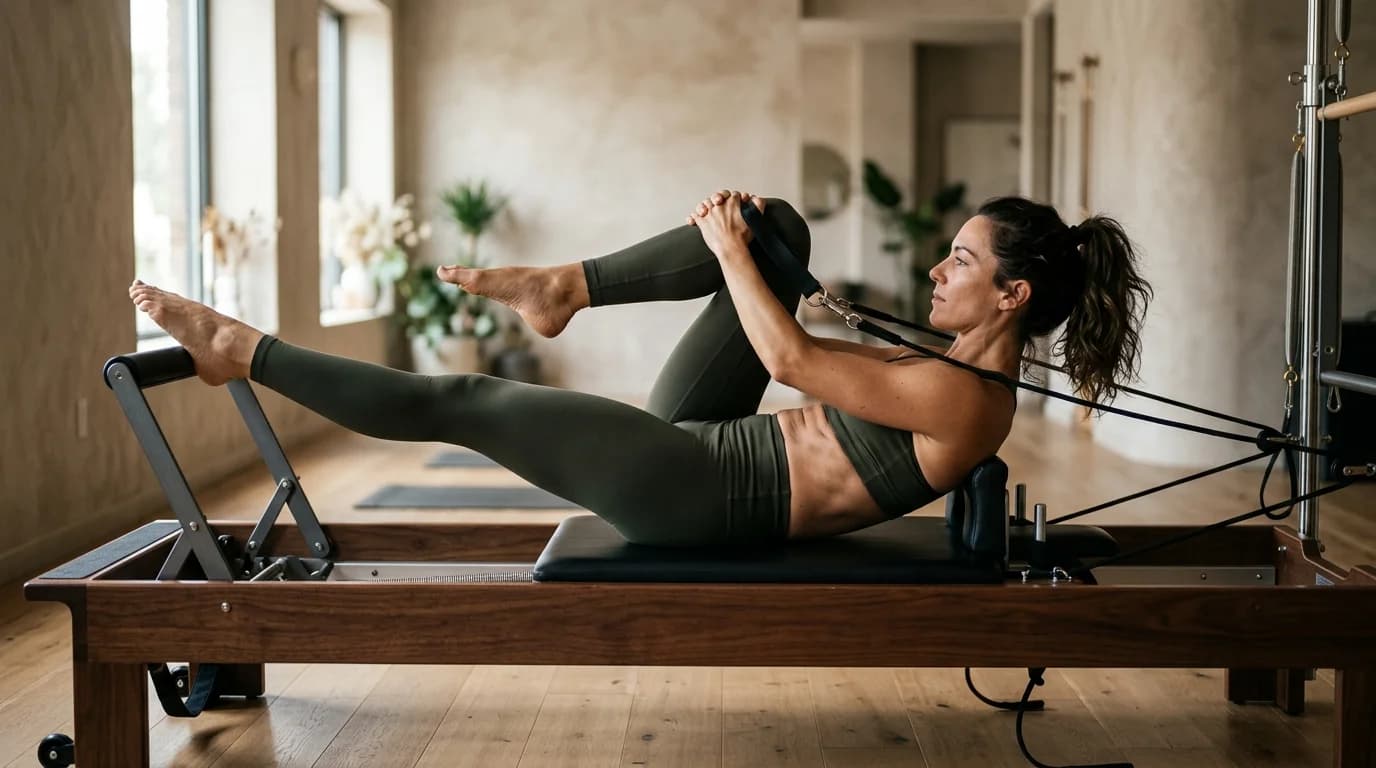
This guide is for educational discovery only. If you have pain, an injury, pregnancy, postnatal considerations, or a specific medical concern, speak to a qualified Pilates instructor or appropriate healthcare professional before trying new exercises.
Quick Answer
Reformer Pilates for core strength usually focuses on controlled trunk movement, breathing, pelvic organisation, and the ability to manage spring resistance without rushing or losing position. Useful exercises to explore include Hundred Prep, Frog in Straps, Leg Circles in Straps, Bridging on Reformer, and Elephant, depending on level and instructor guidance.
Who This Guide Is For
This guide may be useful if you:
- want to understand how reformer Pilates relates to core strength
- are looking for beginner-friendly core exercises on the reformer
- want to understand the difference between core strength, core control, and core stability
- are trying to connect core exercises to equipment such as the reformer, straps, and footbar
- want to know which questions to ask an instructor before progressing core exercises
- are browsing the site and want a clear route into core-focused exercise pages
This is not a personalised training plan. Core work can feel very different depending on spring setup, body position, range, and individual experience.
What Core Strength Means In Reformer Pilates
In reformer Pilates, core strength is not only about doing abdominal exercises or making the movement look difficult. It is usually about how well the trunk, pelvis, ribs, and breath are organised during movement.
A core-focused reformer exercise may ask the user to:
- control the carriage without momentum
- keep the pelvis organised while the legs move
- coordinate breathing with movement
- maintain trunk support during arm or leg work
- control range rather than forcing it
- stay steady while springs or straps create feedback
This is why some exercises that do not look like “core exercises” can still be relevant to core strength. For example, Frog in Straps can challenge trunk and pelvic control while the legs move in the straps. Bridging on Reformer can connect core awareness with glutes, hamstrings, and pelvic control.
Core strength in this context is better understood as control and coordination, not just effort.
Why The Reformer Is Useful For Core Control
The reformer gives feedback. The carriage moves, the springs change resistance, and the straps respond to how evenly and smoothly the user moves. That feedback can make core work easier to understand.
For example, if the carriage moves unevenly or returns too quickly, the user may need to slow down, adjust range, or find more trunk control. If the straps pull unevenly, the user may need to organise the pelvis, ribs, or shoulders more clearly.
The reformer can support core learning because it allows:
- supported positions for beginners
- spring feedback during movement
- strap-based leg or arm work
- gradual progressions
- clear links between breath, control, and movement quality
A useful core exercise should help the user notice how they are moving, not just make them feel tired.
Core Exercises To Explore
These exercises connect well to core strength because they involve trunk control, breathing, pelvic organisation, or coordination with the reformer equipment.
Hundred Prep
- Level: Beginner
- Why it fits: Introduces breath rhythm, abdominal endurance, and trunk control before more demanding versions of the Hundred.
- Equipment: Reformer
- Related areas: core muscles, core
- View exercise: Hundred Prep
Frog In Straps
- Level: Beginner
- Why it fits: Helps users explore hip movement while keeping the pelvis and trunk organised.
- Equipment: Reformer, straps
- Related areas: core muscles, hips, glutes
- View exercise: Frog in Straps
Leg Circles In Straps
- Level: Intermediate
- Why it fits: Builds on strap control by asking the user to manage circular leg movement while maintaining trunk and pelvic organisation.
- Equipment: Reformer, straps
- Related areas: core muscles, hips, lower-body control
- View exercise: Leg Circles in Straps
Bridging On Reformer
- Level: Beginner
- Why it fits: Connects glute, hamstring, pelvic, and trunk control in a supported position.
- Equipment: Reformer
- Related areas: glutes, hamstrings, core muscles
- View exercise: Bridging on Reformer
Footwork Series
- Level: Beginner
- Why it fits: Teaches carriage control and lower-body alignment while the user maintains trunk support.
- Equipment: Reformer, footbar
- Related areas: lower body, core, glutes, hamstrings
- View exercise: Footwork Series
Elephant
- Level: Intermediate
- Why it fits: Can challenge trunk support, shoulder organisation, hamstring length, and carriage control from a more demanding position.
- Equipment: Reformer, footbar
- Related areas: core muscles, hamstrings, back
- View exercise: Elephant
Beginner Vs Intermediate Core Work
Beginner core work should usually focus on understanding the basics:
- breath rhythm
- stable setup
- supported positions
- controlled range
- smooth carriage movement
- avoiding momentum
- knowing when to reduce difficulty
Good beginner pages include:
Intermediate core work may add:
- larger ranges
- more strap coordination
- less supported positions
- more precise carriage control
- stronger shoulder or hip demands
- more complex transitions
Useful intermediate pages include:
The key is not to rush. A harder-looking exercise is not automatically a better core exercise. Good progression should improve movement quality, not just difficulty.
Equipment Used For Core-Focused Exercises
Reformer
The reformer is the main apparatus. It gives feedback through the carriage, springs, straps, and body position. Core-focused work often asks the user to manage that feedback with control.
Straps
Straps are useful for core work because they allow the arms or legs to move while the trunk and pelvis stay organised. Frog in Straps and Leg Circles in Straps are strong examples.
Footbar
The footbar gives a stable point of contact. Exercises such as Footwork Series and Elephant can connect footbar work to trunk support and carriage control.
Muscles And Body Areas Commonly Involved
Core-focused reformer Pilates often involves more than the abdominal muscles alone. The exact focus depends on the exercise, setup, spring choice, and instructor cues.
Commonly involved pages include:
- Core muscles for trunk support and control
- Glutes for bridging, hip control, and lower-body support
- Hamstrings for bridging, footwork, and posterior-chain control
- Upper back for shoulder organisation and posture support
- Core, hips, back, and lower body as broader body areas
A useful way to think about core work is that the trunk helps organise the rest of the movement. The legs, arms, hips, and shoulders may be moving, but the core helps manage control and coordination.
Common Core Strength Misconceptions
Core strength is not just abdominal fatigue
Feeling tired in the abs does not automatically mean the movement was controlled or useful. Core work should involve breath, alignment, and movement quality.
Harder exercises are not always better
A more advanced-looking exercise may be less useful if the user loses control. Beginner exercises such as Hundred Prep or Frog in Straps can be more valuable when performed with good awareness.
The legs can move while the core works
Core strength does not only happen in exercises that look like sit-ups. Strap exercises, bridging, and footbar work can all involve trunk control.
Spring settings matter
A spring setting can support the movement or increase the challenge. Beginners should ask whether the springs are helping stability or asking for more control.
Core work should not be rushed
Slow, controlled movement often reveals more than fast movement. If the carriage or straps are moving too quickly, the user may need to reduce the range or ask for guidance.
How To Progress Core Exercises Sensibly
A sensible core progression should improve control before adding complexity. Progression might mean:
- smoother carriage movement
- better breath coordination
- more consistent pelvic control
- larger range with the same quality
- moving from supported to less supported positions
- using straps with more control
- adding coordination only when the base movement is understood
A possible discovery route could be:
1. Hundred Prep for breath and trunk control 2. Bridging on Reformer for glutes, hamstrings, and pelvic awareness 3. Frog in Straps for strap-based hip and core control 4. Leg Circles in Straps for a more demanding strap progression 5. Elephant for carriage control from a more challenging position
This is not a fixed programme. It is a content pathway to help users understand what to explore and what to ask an instructor.
What To Ask An Instructor
Useful questions include:
- Which core exercises are suitable for my current level?
- What should I feel working in this exercise?
- Am I using my breath correctly?
- How should my pelvis and ribs be organised?
- Which spring setting should I use?
- Is the spring setting supporting me or making the exercise harder?
- What should I do if my neck, hips, or back take over?
- What is an easier version of this exercise?
- What exercise should I learn before progressing?
- How do I know when I am ready for a harder core exercise?
If a core exercise causes pain or feels unsafe, stop and ask for guidance.
FAQs
Is reformer Pilates good for core strength?
Reformer Pilates can be useful for exploring core strength because the carriage, springs, and straps give feedback during movement. Core-focused exercises often ask the user to control the trunk, pelvis, breath, and range of movement rather than simply move quickly or force effort.
What are good beginner reformer exercises for core strength?
Good beginner pages to explore include Hundred Prep, Frog in Straps, Bridging on Reformer, and Footwork Series. The best choice depends on your level, setup, and instructor guidance.
Are strap exercises good for core work?
Strap exercises can connect well to core control because the arms or legs move while the trunk and pelvis need to stay organised. Frog in Straps is a useful beginner example, while Leg Circles in Straps may be more demanding.
Is core strength the same as core stability?
They are related, but not identical. Core strength often refers to the ability to create and manage force, while core stability usually refers to maintaining control and organisation during movement. In Pilates, the two often overlap. See Core Stability vs Core Strength in Pilates for more detail.
Should core exercises feel hard straight away?
Not necessarily. A good core exercise should feel controlled and understandable. If the exercise feels confusing, painful, or impossible to control, it may be too advanced for now or need a different setup.
Which equipment is used for core-focused reformer exercises?
Core-focused exercises may use the reformer, straps, footbar, or other props depending on the exercise. The equipment changes the level of support, resistance, and feedback.
Can beginners do reformer Pilates for core strength?
Beginners can explore core strength with appropriately chosen exercises. Hundred Prep, Frog in Straps, and Bridging on Reformer are useful starting points when taught with suitable spring settings and modifications.
Where should I go next?
Start with Beginner Core Reformer Exercises if you want a curated list. If you are new to the reformer overall, read Reformer Pilates for Beginners first, then explore the core strength goal page and related exercises.