Guide · Core strength
How Reformer Pilates Trains Core Control
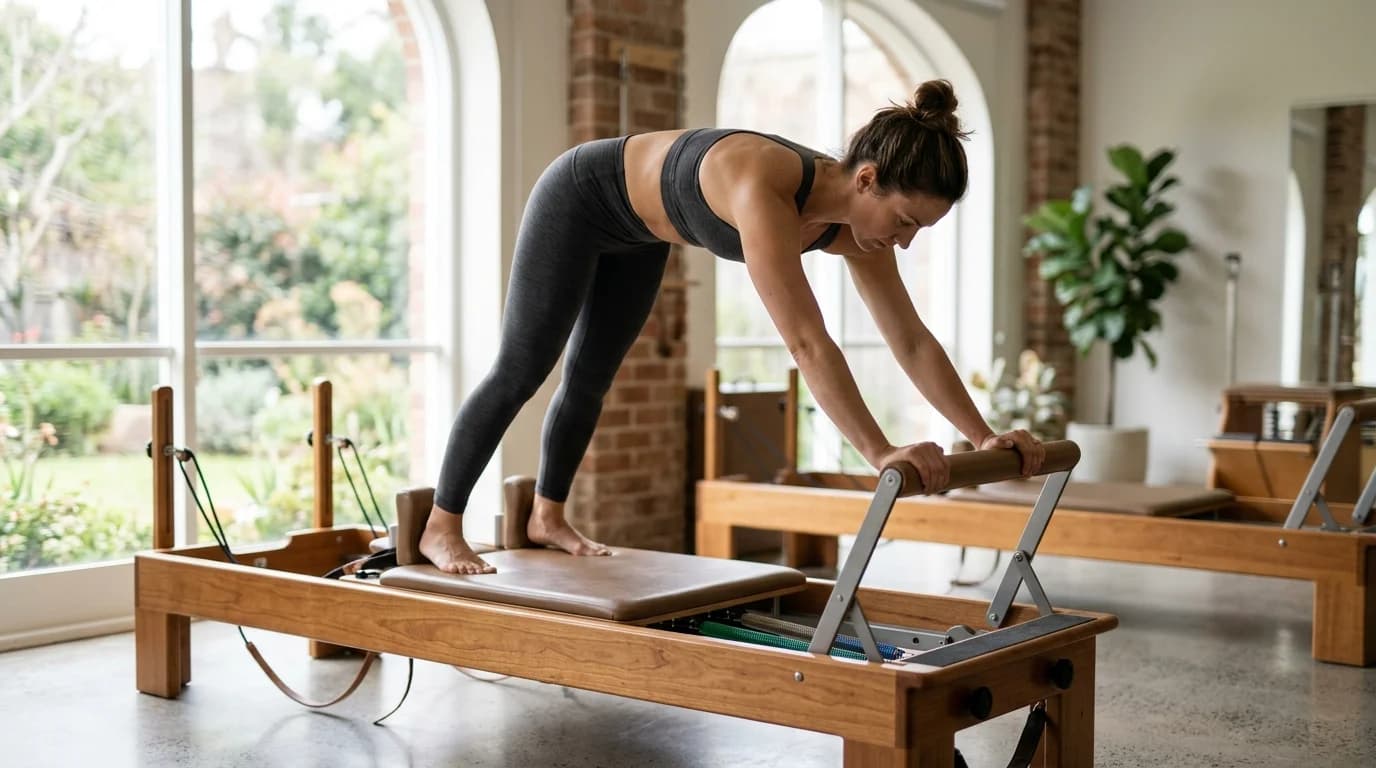
Reformer Pilates can train core control by asking the trunk, pelvis, ribs, and breath to stay organised while the carriage, springs, straps, arms, or legs move. This guide explains how the reformer creates feedback, w…
This guide is for educational discovery only. If you have pain, an injury, pregnancy, postnatal considerations, or a specific medical concern, speak to a qualified Pilates instructor or appropriate healthcare professional before trying new exercises.
Quick Answer
Reformer Pilates trains core control by using the carriage, springs, straps, and body position to create feedback during movement. The user learns to organise the trunk, pelvis, ribs, and breath while the arms or legs move. Exercises such as Hundred Prep, Frog in Straps, Bridging on Reformer, and Leg Circles in Straps can all help explore core control with appropriate instruction.
What Core Control Means
Core control is the ability to stay organised through the trunk while movement happens elsewhere. In reformer Pilates, this usually means the pelvis, ribs, spine, shoulders, and breath are coordinated rather than braced or forced.
It is not simply about holding the stomach tight. A user may be doing core work even when the movement is led by the legs, arms, hips, or shoulders.
For example:
- in Frog in Straps, the legs move while the pelvis and trunk stay organised
- in Footwork Series, the legs press the carriage while the trunk remains supported
- in Hundred Prep, breathing and trunk support work together
- in Bridging on Reformer, the core connects with glutes, hamstrings, and pelvic control
A useful way to explain core control is: the core helps manage the movement, rather than simply making the movement harder.
How The Reformer Creates Feedback
The reformer is useful because it responds to the user. The carriage moves, the springs create resistance or support, and the straps pull through the pulley system. If the user rushes, loses position, or moves unevenly, the equipment often makes that visible or noticeable.
This feedback can help users understand movement quality. For example:
- the carriage may move too quickly if the user is relying on momentum
- the straps may pull unevenly if the pelvis or shoulders are not organised
- the spring setting may feel unstable if the user is not controlling the range
- the return phase may feel harder than the outward phase
This is one reason reformer Pilates can be useful for core learning. The equipment gives the user something to feel and respond to.
The Role Of Springs
Springs create resistance, but they can also provide support. This matters for core control because the spring setting changes how much control the user needs to create.
A heavier spring may create more resistance in one exercise, but it may also make the carriage feel more stable in another. A lighter spring may feel easier in theory, but it can sometimes demand more control because the carriage moves more freely.
For core-focused exercises, spring settings affect:
- how stable the carriage feels
- how much the user needs to control the return
- how much support the straps provide
- how much range is manageable
- whether the movement feels smooth or unstable
Beginners should not guess spring settings. They should ask an instructor whether the spring is being used for support, challenge, or feedback.
The Role Of The Carriage
The carriage is the moving platform on the reformer. It can show whether the user is moving with control or relying on momentum.
In a core-focused exercise, the carriage may need to move smoothly, return quietly, or stay steady while another part of the body moves. If the carriage jerks, bangs, or moves faster than expected, that can be useful feedback.
Exercises such as Footwork Series and Elephant use carriage control in different ways. Footwork is often more beginner-friendly because the body is more supported. Elephant can be more demanding because the position requires more trunk, shoulder, and hamstring control.
The carriage helps users learn that core control is not only about effort. It is also about timing, organisation, and smooth movement.
The Role Of Straps
Straps are especially useful for core control because they allow the arms or legs to move while the trunk and pelvis need to stay organised.
In Frog in Straps, the legs bend and extend while the user works to keep the pelvis steady. In Leg Circles in Straps, the circular leg movement asks for more control because the range and direction change throughout the exercise.
Straps can reveal:
- whether one side is pulling more than the other
- whether the user is controlling the return
- whether the pelvis shifts as the legs move
- whether the range is too large
- whether the spring setting is appropriate
For beginners, strap work should usually start with a clear setup and a manageable range.
Breathing And Core Control
Breathing is not separate from core control. In many Pilates exercises, the breath helps the user organise the ribs, trunk, and timing of the movement.
In Hundred Prep, breath rhythm is part of the exercise. The user is not just trying to hold a position; they are learning how to coordinate breathing with trunk support.
Beginners often hold their breath when an exercise feels difficult. That may be a sign the exercise is too demanding, the range is too large, or the user needs a clearer cue.
Useful breath-related questions include:
- When should I inhale?
- When should I exhale?
- Am I holding tension unnecessarily?
- Should the movement become smaller so I can breathe more easily?
Core Control Exercises To Explore
Hundred Prep
- Why it fits: Introduces breath rhythm and trunk support in a focused way.
- Equipment: Reformer
- View exercise: Hundred Prep
Frog In Straps
- Why it fits: Shows how the legs can move while the pelvis and trunk stay organised.
- Equipment: Reformer, straps
- View exercise: Frog in Straps
Bridging On Reformer
- Why it fits: Connects trunk control with glutes, hamstrings, and pelvic organisation.
- Equipment: Reformer
- View exercise: Bridging on Reformer
Footwork Series
- Why it fits: Helps users explore trunk support while the legs press and return the carriage.
- Equipment: Reformer, footbar
- View exercise: Footwork Series
Leg Circles In Straps
- Why it fits: Adds more range and coordination to strap-based core control.
- Equipment: Reformer, straps
- View exercise: Leg Circles in Straps
Elephant
- Why it fits: Challenges carriage control, trunk support, shoulder organisation, and hamstring involvement from a more demanding position.
- Equipment: Reformer, footbar
- View exercise: Elephant
What Good Control May Look Like
Good core control is not always dramatic. It may look calm, steady, and precise.
Signs of useful control may include:
- the carriage moves smoothly
- the return is controlled
- the user can breathe during the movement
- the pelvis does not rock around unnecessarily
- the ribs and shoulders stay organised
- the straps move evenly
- the user can reduce range without losing the exercise
- the movement feels understandable rather than chaotic
A beginner does not need perfect control. The goal is to notice what is happening and improve gradually.
Common Misconceptions
Core control means bracing hard
Bracing may make the body feel tense, but it is not the same as useful control. In Pilates, the goal is usually coordinated support with breath and movement.
Core work only happens in abdominal exercises
Core control can appear in strap work, footbar work, bridging, and posture-focused exercises. The core helps organise movement across the body.
Faster movement shows strength
Fast movement can hide a lack of control. Slower movement often gives better feedback, especially when learning.
Lighter springs are always easier
Lighter springs may make the carriage less supported, which can demand more control. Spring settings should be chosen for the exercise and the user.
Bigger range is always better
A smaller range with control is usually more useful than a larger range that causes the user to lose position.
What To Ask An Instructor
Useful questions include:
- What is this exercise trying to teach about core control?
- What should I feel working?
- How should my pelvis and ribs be organised?
- Am I holding my breath?
- Which spring setting should I use?
- Is the spring giving me support or adding challenge?
- What should I do if the carriage moves too quickly?
- What should I do if the straps pull unevenly?
- Can I reduce the range and still get the benefit?
- What is the next progression after this exercise?
If an exercise feels painful, unsafe, or confusing, stop and ask for help.
FAQs
How does reformer Pilates train core control?
Reformer Pilates trains core control by asking the user to organise the trunk, pelvis, ribs, and breath while the carriage, straps, springs, arms, or legs move. The equipment gives feedback that can help the user notice whether they are moving smoothly or losing control.
Is core control the same as core strength?
They are related, but not exactly the same. Core strength often refers to the ability to create and manage force, while core control is about organising the trunk during movement. In Pilates, the two often overlap.
Why are straps useful for core control?
Straps are useful because the arms or legs move while the trunk and pelvis need to stay organised. Exercises such as Frog in Straps and Leg Circles in Straps show this clearly.
Why does the carriage matter for core work?
The carriage gives feedback. If it moves too quickly, returns abruptly, or feels hard to control, the user may need to adjust the range, spring setting, or trunk organisation.
Can beginners train core control on the reformer?
Yes, beginners can explore core control with suitable exercises and instruction. Useful starting points include Hundred Prep, Frog in Straps, Bridging on Reformer, and Footwork Series.
Should core control exercises feel intense?
They may feel challenging, but they should not feel chaotic or unsafe. A good core-control exercise should feel understandable enough that the user can breathe, adjust range, and move with awareness.
What if my back, hips, or neck take over?
Stop and ask for guidance. The exercise may need a different setup, a smaller range, a spring adjustment, or an easier variation. Do not push through pain or confusion.
Where should I go next?
Read Reformer Pilates for Core Strength for the wider overview, or Beginner Core Reformer Exercises for a practical list of starting exercises.