Guide · Core strength
Beginner Core Reformer Exercises
Beginner core reformer exercises should help users understand trunk control, breathing, spring feedback, and pelvic organisation before moving into more complex core progressions. This guide highlights beginner-friend…
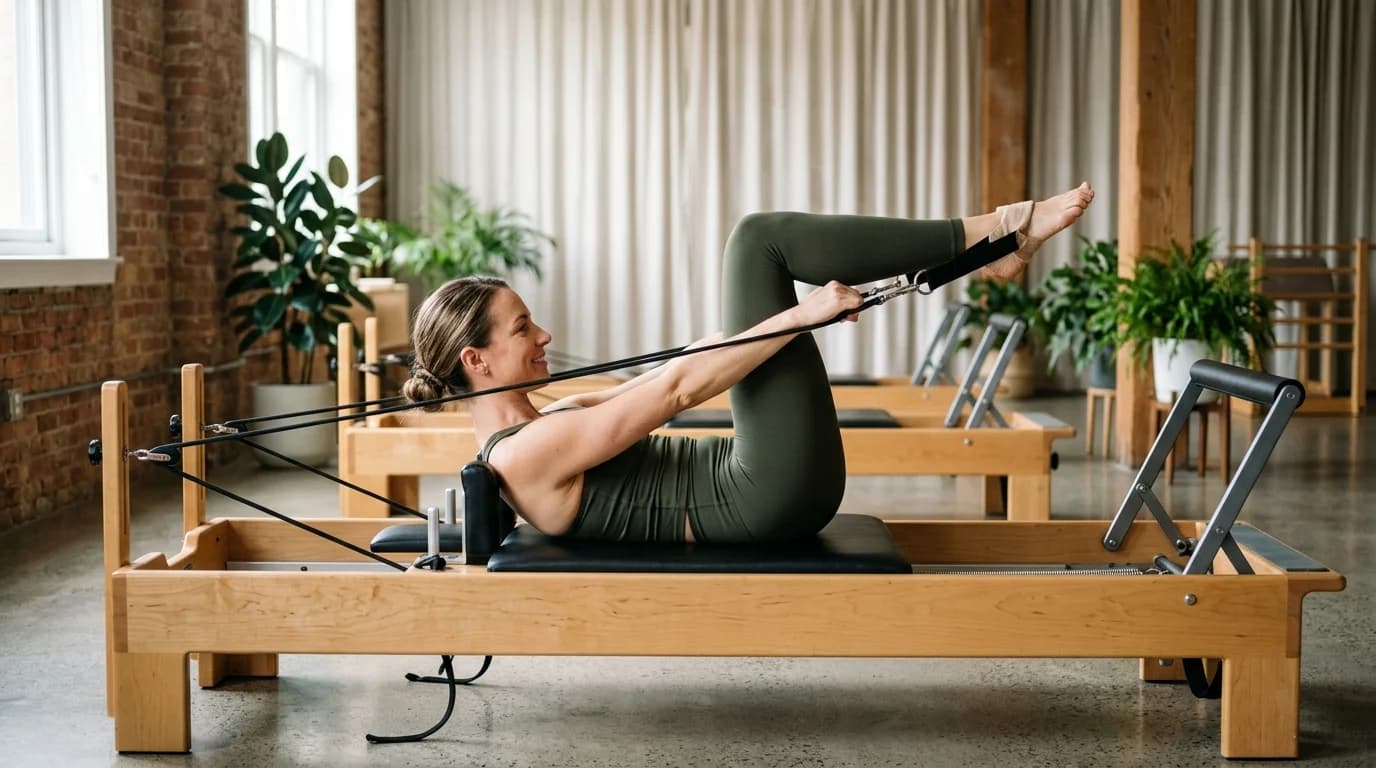
This guide is for educational discovery only. If you have pain, an injury, pregnancy, postnatal considerations, or a specific medical concern, speak to a qualified Pilates instructor or appropriate healthcare professional before trying new exercises.
Quick Answer
Good beginner core reformer exercises usually use supported positions, clear setup, and controlled movement so the user can focus on breathing, trunk support, and pelvic organisation. Useful starting points include Hundred Prep, Frog in Straps, Bridging on Reformer, and Footwork Series, depending on the user’s level and instructor guidance.
What Makes A Core Exercise Beginner-Friendly?
A beginner-friendly core exercise should help the user understand control rather than simply make the movement feel hard. In reformer Pilates, core work often involves keeping the trunk, pelvis, ribs, and breath organised while another part of the body moves.
This means a useful beginner core exercise often has:
- a supported body position
- a clear breathing pattern
- a manageable range of movement
- enough spring or strap feedback to understand control
- a simple movement pattern
- a clear way to reduce difficulty
- a sensible progression path
Beginner core work does not have to look dramatic. Exercises such as Hundred Prep and Frog in Straps can be useful because they teach the user how to stay organised while breathing, moving the legs, or managing spring feedback.
Beginner Core Exercises To Explore
These exercises are useful starting points because they connect core strength to control, breathing, equipment awareness, and beginner-friendly movement patterns.
Hundred Prep
- Level: Beginner
- Why it fits: Hundred Prep introduces breath rhythm, trunk support, and abdominal endurance before more demanding versions of the Hundred.
- Good for exploring: breathing, core awareness, trunk control, beginner endurance
- Equipment: Reformer
- Related areas: core muscles, core
- View exercise: Hundred Prep
Frog In Straps
- Level: Beginner
- Why it fits: Frog in Straps lets users explore hip movement while keeping the pelvis and trunk organised.
- Good for exploring: strap feedback, hip control, pelvic organisation, core coordination
- Equipment: Reformer, straps
- Related areas: core muscles, hips, glutes
- View exercise: Frog in Straps
Bridging On Reformer
- Level: Beginner
- Why it fits: Bridging connects the core with glutes, hamstrings, and pelvic control in a supported position.
- Good for exploring: pelvic awareness, posterior-chain control, trunk support, slow movement
- Equipment: Reformer
- Related areas: core muscles, glutes, hamstrings, hips
- View exercise: Bridging on Reformer
Footwork Series
- Level: Beginner
- Why it fits: Footwork may look lower-body focused, but it can help beginners learn trunk support while the legs press the carriage away and return with control.
- Good for exploring: carriage control, lower-body alignment, trunk support, footbar confidence
- Equipment: Reformer, footbar
- Related areas: core, lower body, glutes, hamstrings
- View exercise: Footwork Series
Mermaid Stretch
- Level: Beginner
- Why it fits: Mermaid Stretch can help beginners connect breathing, side-body movement, and trunk awareness without needing a complex core sequence.
- Good for exploring: breath-led movement, side-body mobility, posture awareness, trunk organisation
- Equipment: Reformer
- Related areas: core, back, posture support
- View exercise: Mermaid Stretch
How To Choose Where To Start
If you are completely new to core work on the reformer, begin with exercises that make the task easy to understand.
A useful starting route might be:
1. Footwork Series to understand carriage control and trunk support 2. Hundred Prep to focus more directly on breathing and core awareness 3. Bridging on Reformer to connect the core with glutes, hamstrings, and pelvic control 4. Frog in Straps to add strap feedback and hip movement 5. Mermaid Stretch to explore breath, side-body movement, and trunk awareness
This is not a fixed workout plan. It is a discovery route that helps users understand which pages to explore and which questions to ask an instructor.
If an exercise feels confusing, unstable, or too hard to control, it may be worth returning to a simpler setup or asking for a modification.
Beginner Core Exercises By Equipment
Reformer-only starting points
These exercises use the reformer without needing strap complexity.
Useful pages:
Footbar-based starting points
The footbar can help beginners feel more grounded while learning carriage control.
Useful pages:
Strap-based starting points
Straps can be useful for core work because the legs or arms move while the trunk and pelvis need to stay organised.
Useful pages:
Future progressions
Once a user has more control, they may explore more demanding core-related pages such as:
What Core Control Should Feel Like
Core control in reformer Pilates should usually feel organised rather than forced. The user may feel the abdominal area working, but they may also notice the glutes, hamstrings, hips, back, or upper body depending on the exercise.
Useful signs of control include:
- the carriage moves smoothly
- breathing stays steady
- the pelvis feels organised rather than rocking around
- the shoulders are not taking over unnecessarily
- the movement range feels manageable
- the user can slow down without losing the exercise
- the exercise feels understandable, not chaotic
It is common for beginners to expect core work to mean strong abdominal fatigue. In Pilates, a better sign is often whether the user can stay controlled while moving.
Common Beginner Mistakes
Thinking core work only means abs
Core-focused reformer exercises often involve the trunk, pelvis, hips, glutes, hamstrings, and back working together. It is not only about feeling the abdominal muscles burn.
Moving too quickly
If the carriage or straps move too quickly, the user may be relying on momentum. Slower movement can reveal whether the core is supporting the movement.
Choosing advanced exercises too soon
Exercises such as Leg Circles in Straps or Elephant may be useful later, but many beginners benefit from learning Hundred Prep, Frog in Straps, and Bridging on Reformer first.
Ignoring breath
Breathing is part of the exercise. If the user holds their breath or loses rhythm, they may need to reduce the range or slow the movement.
Forcing range
A large range is not automatically better. Beginners should use a range they can control.
When To Progress
A beginner may be ready to explore harder core exercises when they can:
- control the carriage smoothly
- breathe without holding tension
- maintain pelvic organisation
- move through a manageable range
- understand the exercise setup
- follow cues without feeling rushed
- reduce momentum
- recognise when control is lost
Progression could mean a harder exercise, but it could also mean better quality in the same exercise. For example, improving Hundred Prep or Frog in Straps may be more useful than jumping ahead too soon.
Useful next pages:
- Reformer Pilates for Core Strength
- How Reformer Pilates Trains Core Control
- Reformer Pilates Exercise Progressions
What To Ask An Instructor
Useful questions include:
- Which beginner core exercises are suitable for my current level?
- What should I feel during this exercise?
- Am I using my breath correctly?
- How should my pelvis and ribs be positioned?
- Which spring setting should I use?
- Should this exercise feel supported or challenging?
- What should I do if my neck, hips, or back take over?
- Can I use a smaller range of movement?
- What is an easier version of this exercise?
- What should I practise before progressing?
If an exercise causes pain or feels unsafe, stop and ask for guidance.
FAQs
What are the best beginner core reformer exercises?
Useful beginner core reformer exercises include Hundred Prep, Frog in Straps, Bridging on Reformer, and Footwork Series. The best starting point depends on the user’s level, spring setup, and instructor guidance.
Is Hundred Prep a beginner core exercise?
Yes, Hundred Prep can be a useful beginner core exercise because it introduces breath rhythm, trunk support, and abdominal endurance before more demanding versions of the Hundred.
Are straps useful for beginner core exercises?
Straps can be useful for beginner core work when the exercise is set up appropriately. Frog in Straps is a good example because the body is supported while the legs move and the trunk works to stay organised.
Can footwork help with core strength?
Yes, Footwork Series can support core awareness because the user needs to maintain trunk organisation while the legs press and return the carriage. It is not only a lower-body exercise.
How do I know if a core exercise is too hard?
An exercise may be too hard for now if the user cannot control the carriage, holds their breath, loses pelvic organisation, feels unsafe, or cannot understand the setup. An instructor can offer an easier version or reduce the range.
Should beginner core exercises feel intense?
They may feel challenging, but they should not feel chaotic, painful, or impossible to control. Beginner core work should prioritise control, breathing, and understanding before intensity.
What should I ask an instructor about core exercises?
Ask what the exercise is trying to teach, which spring setting to use, what you should feel working, and how to modify the movement if your neck, hips, or back take over.
Where should I go next?
Read Reformer Pilates for Core Strength for the wider overview. Then explore Hundred Prep, Frog in Straps, and the core strength goal page.