Guide · Equipment & apparatus
Reformer Straps Guide
Reformer [straps](/equipment/straps) connect to the pulley and spring system at one end of the [reformer](/equipment/reformer). They are used for arm and leg exercises where the user pulls or controls movement against…
This guide is for educational discovery only. If you have pain, an injury, pregnancy, postnatal considerations, or a specific medical concern, speak to a qualified Pilates instructor or appropriate healthcare professional before trying new exercises.
Quick Answer
Reformer straps are fabric loops attached to ropes and pulleys on the reformer. They are used for leg and arm exercises where spring resistance provides feedback and challenge. Beginner-friendly strap exercises include Frog in Straps for hip control and Chest Expansion for upper-back awareness. Strap setup, loop choice, and spring settings should always be guided by a qualified instructor.
Who This Guide Is For
This guide may be useful if you:
- are new to reformer Pilates and want to understand strap exercises
- have seen straps on a reformer and are unsure how they are used
- want to know which strap exercises are suitable for beginners
- are preparing for your first class and want to recognise strap terminology
- want to explore exercises connected to hip mobility or posture support
- want better questions to ask before trying strap work
Strap exercises are common in reformer classes, but they are not always introduced in the first session. Many instructors begin with footbar work such as Footwork Series before moving to straps.
What Are Reformer Straps?
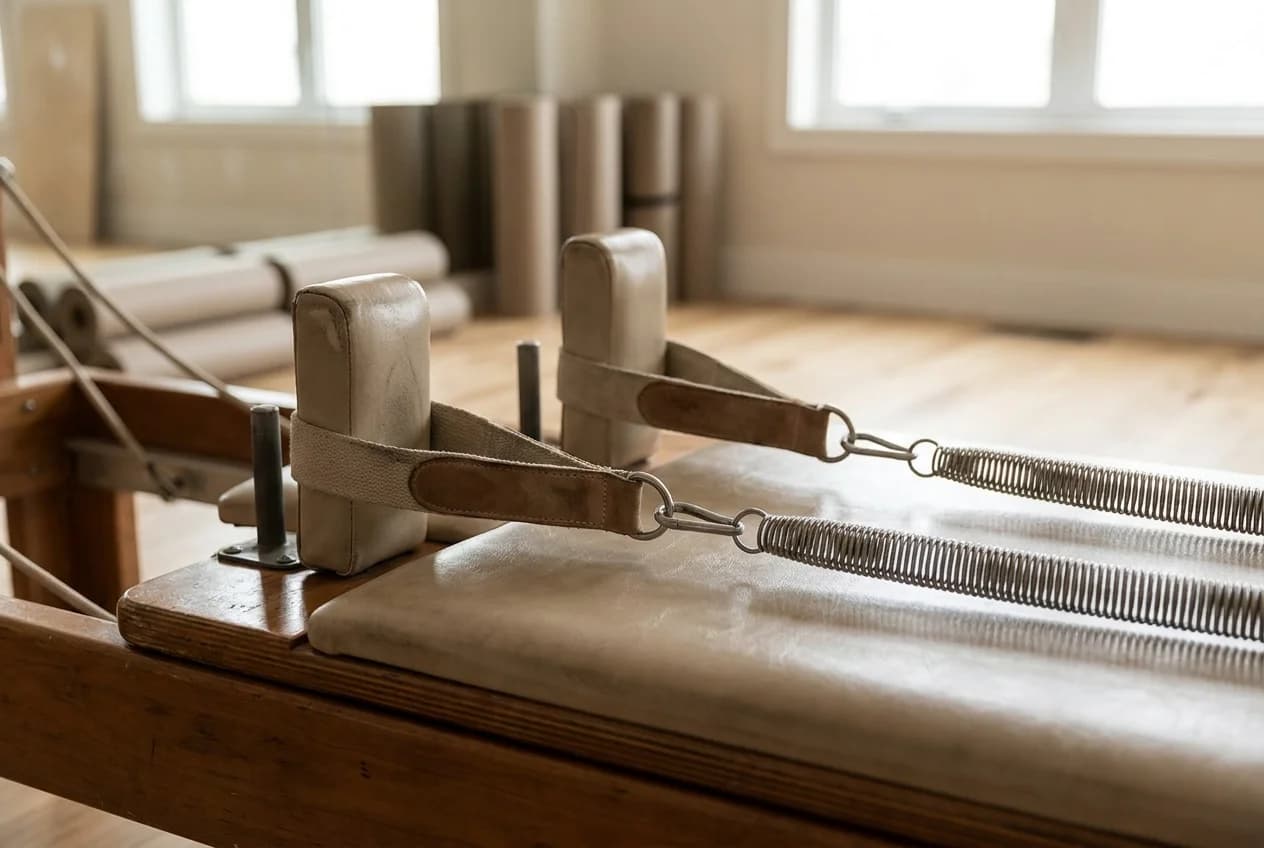
Straps are one of the main contact points on the reformer alongside the footbar, shoulder blocks, and carriage. They are typically made of padded fabric and attach to ropes that run through pulleys at the top of the reformer frame.
Unlike the footbar, which gives a fixed point to press against, straps move with the user. That movement is controlled by the spring system, so the straps can feel supportive in one exercise and demanding in another.
Straps are commonly used for:
- leg exercises while lying on the carriage
- arm exercises while sitting, kneeling, or standing
- pulling exercises on the long box
- coordination and range-of-movement work
The experience depends on body position, spring setting, strap length, and the exercise selected. That is why setup matters more with straps than with many footbar exercises.
How Straps Connect To The Reformer
On most reformers, straps connect to a rope-and-pulley system at the head of the machine. When the user pulls or presses, the rope moves through the pulleys and the carriage may move along the rails depending on the exercise.
For beginners, the important idea is that straps are not passive handles. They are part of a spring-loaded system. When you move the straps, you also move against resistance, and sometimes the carriage moves too.
Key concepts to understand:
- Spring setting affects how heavy or light the straps feel
- Strap length affects how far the user can reach and how much range is available
- Body position changes which muscles work and how stable the trunk feels
- Loop choice (which part of the strap you use) changes hand or foot placement
If any of these feel wrong during class, ask the instructor before continuing. A small setup change can make a strap exercise feel much clearer.
Strap Loops And Setup Basics
Most reformer straps have more than one loop or a long strap that can be adjusted. The instructor will usually tell you which loop to use for feet, hands, or other positions.
Common setup considerations include:
- Feet in straps — often used for supine leg exercises such as Frog in Straps
- Hands in straps — used for arm and upper-back exercises such as Chest Expansion
- Strap length — too long or too short can change range and control
- Shoulder blocks — help keep the body stable when lying on the carriage with feet in straps
Beginners should not guess loop placement or strap length. Wait for clear setup guidance, especially the first time you try a strap exercise.
Useful orientation page:
What Strap Exercises Feel Like For Beginners
Strap exercises often feel different from footbar work because the contact point moves. Beginners may notice:
- the legs or arms feel lighter or heavier than expected
- the trunk has to work to stay organised
- the carriage may want to move when it should stay still, or vice versa
- coordination between breath, range, and control takes attention
That is normal. Strap work rewards patience. A well-chosen beginner exercise gives enough support to learn without overwhelming the user.
If you are completely new to the reformer, it can help to read What to Expect in Your First Reformer Pilates Class and explore Beginner Reformer Pilates Exercises before focusing on straps.
Beginner Strap Exercises To Explore
These exercises from the current library are useful starting points for understanding strap work. Your instructor will decide which are appropriate for your level and setup.
Frog in Straps
Frog in Straps is one of the most useful beginner strap exercises. It introduces controlled hip movement while the user lies on the carriage with feet in the straps. It connects to hip mobility, pelvic control, and core strength.
Why beginners explore it:
- the body is supported on the carriage
- the movement pattern is relatively clear
- it teaches how straps respond to leg movement
- it builds awareness of trunk stability during leg work
Leg Circles in Straps
Leg Circles in Straps may follow once basic hip control is established. It adds circular range and coordination. Depending on range and spring setting, it can feel more demanding than frog.
Why it matters:
- explores hip mobility in multiple directions
- asks for trunk and pelvic stability during movement
- helps users understand how to control strap speed and range
Chest Expansion
Chest Expansion is a useful strap exercise for the upper body. It can help users explore shoulder organisation, arm path, and upper-back awareness. It connects to posture support.
Why beginners explore it:
- introduces hand-in-strap arm work
- focuses on controlled pulling rather than fast movement
- can build confidence with upright or kneeling strap positions depending on setup
Strap Exercises For Hip Mobility And Core Control
Many leg-in-strap exercises connect naturally to hip mobility and core strength. The straps allow the legs to move while the trunk works to stay stable.
Useful pages:
- Frog in Straps
- Leg Circles in Straps
- Bridging on Reformer — often footbar-based, but useful comparison for hip and glute awareness
When exploring hip-focused strap work, pay attention to:
- whether the pelvis stays level
- whether the lower back over-arches during leg movement
- whether the straps pull the legs faster than you can control
- whether range feels manageable
If control is lost, reducing range or asking for a spring adjustment is reasonable.
Strap Exercises For Upper Body And Posture
Straps are not only for leg work. They are also used for pulling, pressing, and reaching exercises that connect to shoulder control and posture support.
Useful pages:
- Chest Expansion
- Long Box Pulling Straps — uses the long box plus straps; see Long Box Exercises Guide
Upper-body strap exercises often ask the user to:
- keep the trunk organised while the arms move
- control the return phase of the movement
- avoid shrugging or collapsing through the upper back
- match breath to movement
Beginners should expect clear setup guidance for kneeling, sitting, or long box positions.
Common Strap Mistakes
Starting strap work too early without footbar familiarity
Many instructors introduce Footwork Series before strap exercises so the user understands carriage movement and spring feedback. Rushing to straps without that foundation can feel confusing.
Using the wrong loop or strap length
Loop choice and strap length change the exercise significantly. Using the wrong setup can make an exercise feel unstable or awkward.
Letting the straps control the movement
Straps should move because the user initiates and controls the action. If the springs pull the legs or arms back too quickly, the user may need to slow down, reduce range, or ask for a setup change.
Losing trunk organisation
Strap exercises often fail when the trunk collapses or the pelvis shifts. This is common in leg-in-strap work. Focus on staying organised through the centre before increasing range.
Assuming all strap exercises are beginner-friendly
Some strap exercises require significant shoulder mobility, coordination, or inversion tolerance. Leg Circles in Straps and Long Box Pulling Straps may be more appropriate after basic strap confidence is established.
What To Ask An Instructor
Useful strap questions include:
- Which loop should I use for this exercise?
- How long should the straps be for my height and range?
- Is this spring setting giving support or adding challenge?
- Should my carriage stay still or move during this exercise?
- What should I feel working — hips, core, upper back, or arms?
- How do I know if I am moving too fast?
- Is this strap exercise appropriate for my level today?
- What is a sensible progression after Frog in Straps?
If strap work feels unstable or painful, stop and ask before continuing.
FAQs
What are reformer straps used for?
Straps are used for arm and leg exercises on the reformer. They connect to the pulley and spring system, so they provide resistance and feedback. Common uses include supine leg work such as Frog in Straps and upper-body pulling such as Chest Expansion.
Are strap exercises suitable for beginners?
Some strap exercises are beginner-friendly, but not all. Frog in Straps is often introduced early because the body is supported on the carriage. Exercises such as Leg Circles in Straps may require more control. Follow instructor guidance for your level.
Why do reformer straps feel so different from the footbar?
The footbar is a fixed contact point. Straps move with the pulley system and respond to spring tension, so they require more control and coordination. See the Footbar Exercises Guide for comparison.
Which loop should I use on the straps?
Loop choice depends on the exercise, your height, and instructor setup. Do not guess — ask which loop is correct for feet or hands before starting.
Do heavier springs make strap exercises harder?
Not always. Heavier springs can add resistance but may also feel more supported in some positions. Lighter springs can sometimes feel harder because the carriage or straps are less stable. Ask your instructor what the spring setting is intended to do.
What is a good first strap exercise to explore?
Frog in Straps is a useful first strap exercise for many beginners because it introduces hip movement with trunk support. Chest Expansion can be a helpful introduction to hand-in-strap work for the upper body.
Can strap exercises help with hip mobility?
Yes. Exercises such as Frog in Straps and Leg Circles in Straps explore hip movement while asking the trunk to stay organised. They connect to the hip mobility goal, but should be introduced with appropriate setup and range.
Where should I start if I am new to reformer equipment?
Start with Reformer Pilates for Beginners and the Reformer Pilates Equipment Guide. Explore Footwork Series on the footbar first, then move to strap exercises when your instructor introduces them.