Guide · Progression & safety
Beginner to Intermediate Reformer Pilates Exercises
Moving from beginner to intermediate reformer Pilates exercises is not about collecting harder movements. It is about building enough control on the [reformer](/equipment/reformer) that less supported positions, strap…
This guide is for educational discovery only. If you have pain, an injury, pregnancy, postnatal considerations, or a specific medical concern, speak to a qualified Pilates instructor or appropriate healthcare professional before trying new exercises.
Quick Answer
Beginner reformer exercises such as Footwork Series, Bridging on Reformer, Hundred Prep, and Frog in Straps often build the control needed for intermediate work like Elephant, Scooter, Side Splits, and Leg Circles in Straps. Progress when carriage control, breathing, and organisation improve—not when an exercise simply looks more advanced.
What Beginner To Intermediate Means
“Beginner” and “intermediate” on the reformer describe levels of control, not labels of worth. A beginner exercise can still be demanding if it requires patience, breath control, and body awareness. An intermediate exercise may look simple but ask for more organisation in a less supported position.
Beginner exercises in this guide usually share these traits:
- supported body positions
- clear setup on the footbar or straps
- one or two main learning goals
- manageable range that can be reduced easily
Intermediate exercises in this guide often add:
- less supported positions such as kneeling or standing
- larger or more complex ranges
- more coordination between trunk, breath, and limbs
- greater demand on hip organisation and carriage return
For the wider framework, read Reformer Pilates Exercise Progressions.
Beginner Foundation Exercises
These exercises are common starting points. They teach equipment feedback and control that support later progressions.
Footwork Series
Footwork Series introduces carriage movement, foot placement, and lower-body alignment through the footbar.
- Level: beginner foundation
- Good for: beginner confidence, carriage control, posture support
- Equipment: Reformer, footbar
- Often leads to: Scooter, Elephant, Side Splits
- View exercise: Footwork Series
Bridging On Reformer
Bridging on Reformer explores pelvic control, glutes, hamstrings, and trunk support in a lying position.
- Level: beginner foundation
- Good for: core strength, hip mobility
- Equipment: Reformer
- Often leads to: Elephant, Side Splits
- View exercise: Bridging on Reformer
Hundred Prep
Hundred Prep connects breath rhythm with trunk support before harder core progressions.
- Level: beginner foundation
- Good for: core strength, breath-led control
- Equipment: Reformer
- Often leads to: Leg Circles in Straps, Elephant
- View exercise: Hundred Prep
Frog In Straps
Frog in Straps introduces straps and controlled hip movement while the body remains supported.
- Level: beginner foundation for strap work
- Good for: hip mobility, strap awareness, pelvic organisation
- Equipment: Reformer, straps
- Often leads to: Leg Circles in Straps
- View exercise: Frog in Straps
For a wider beginner list, see Beginner Reformer Pilates Exercises and How to Choose Beginner-Friendly Reformer Exercises.
Intermediate Progression Exercises
These exercises often appear after beginner foundations are established. They are not automatically suitable for every user.
Elephant
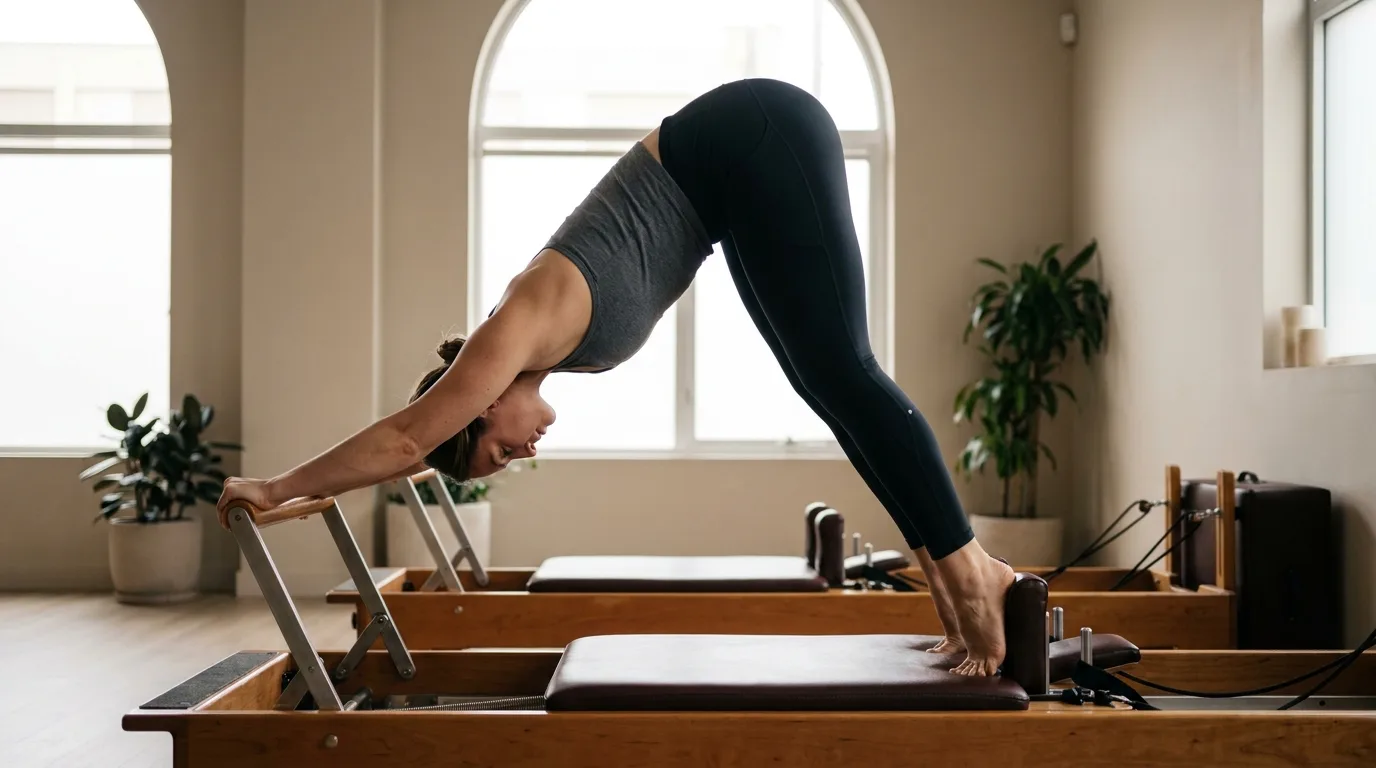
Elephant asks for trunk support, shoulder organisation, hamstring involvement, and carriage control from a less supported position.
- Level: intermediate progression
- Often follows: Footwork Series, Bridging on Reformer, Hundred Prep
- Good for: core strength, posture support
- Equipment: Reformer, footbar
- View exercise: Elephant
Scooter
Scooter challenges single-leg control, balance, and smooth carriage return.
- Level: intermediate progression
- Often follows: Footwork Series with clear leg alignment
- Good for: posture support, lower-body control
- Equipment: Reformer, footbar
- View exercise: Scooter
Side Splits
Side Splits introduces lateral leg movement and standing hip organisation on the reformer.
- Level: intermediate progression
- Often follows: Footwork Series, Bridging on Reformer, Frog in Straps
- Good for: hip mobility, standing control
- Equipment: Reformer, footbar
- View exercise: Side Splits
Leg Circles In Straps
Leg Circles in Straps requires more stability than Frog in Straps because the legs move through a larger circular path.
- Level: intermediate progression for strap work
- Often follows: Frog in Straps, Hundred Prep
- Good for: hip mobility, core strength
- Equipment: Reformer, straps
- View exercise: Leg Circles in Straps
Suggested Progression Pathways
These pathways are examples, not rules. An instructor should adapt them to your level and daily response to the equipment.
Pathway A: Footbar to standing
1. Footwork Series 2. Bridging on Reformer 3. Scooter 4. Side Splits
Useful when building lower-body alignment and standing control.
Pathway B: Core to upright
1. Hundred Prep 2. Bridging on Reformer 3. Frog in Straps 4. Elephant
Useful when building core strength toward less supported positions. See Core Stability vs Core Strength in Pilates.
Pathway C: Straps progression
1. Footwork Series 2. Hundred Prep 3. Frog in Straps 4. Leg Circles in Straps
Useful when introducing straps gradually.
Pathway D: Hip mobility focus
1. Frog in Straps 2. Bridging on Reformer 3. Leg Circles in Straps 4. Side Splits
Useful when hip mobility is a primary goal with control maintained.
Progression By Equipment Type
Footbar progressions
The footbar gives a stable contact point. Common footbar pathways:
Strap progressions
Straps add moving feedback through the limbs. Common strap pathways:
Many users benefit from footbar confidence before heavy strap work. See Reformer Pilates Equipment Guide.
When An Exercise May Be Too Soon
An intermediate exercise may be too soon if:
- beginner foundations still feel rushed or uncontrolled
- the carriage bangs or returns unevenly
- straps pull unevenly or unpredictably
- the user cannot maintain breathing through the movement
- setup requires repeated correction before each rep
- the user is copying shape without understanding purpose
- pain, instability, or confusion appears
This does not mean the exercise is wrong for you forever. It may mean more time on a preparation exercise, a smaller range, or a different spring setting.
Read How to Progress Safely in Reformer Pilates for practical checks.
What To Ask An Instructor
Useful questions include:
- Which beginner exercise best prepares me for this one?
- Am I ready for standing or strap progressions?
- Should I repeat Footwork Series or Frog in Straps before advancing?
- What should I feel working in the intermediate version?
- Can I use a smaller range or easier spring setting?
- How many sessions should I spend on foundations before Elephant or Side Splits?
- What signs tell you I am ready to progress?
Progression should be individual, not competitive.
FAQs
What is the difference between beginner and intermediate reformer exercises?
Beginner exercises usually use supported positions and teach one or two main ideas at a time. Intermediate exercises often add less support, larger range, or more coordination while still requiring control.
Which beginner exercises should I learn first?
Many users start with Footwork Series because the footbar gives clear feedback. Bridging on Reformer, Hundred Prep, and Frog in Straps are also common foundations.
When am I ready for Elephant or Scooter?
Readiness usually includes smooth carriage control, steady breathing, and trunk organisation in footbar work. Elephant and Scooter often follow Footwork Series and core foundations such as Hundred Prep—with instructor confirmation.
Is Leg Circles in Straps harder than Frog in Straps?
Leg Circles in Straps often demands more stability because the legs move through a larger path. Many users benefit from controlled Frog in Straps first.
Can I skip beginner exercises if I am fit?
Fitness in other activities does not always transfer directly to reformer control. The carriage, springs, and setup cues are specific. Foundations often save time later by reducing compensation patterns.
How long should I stay at beginner level?
There is no fixed timeline. Stay until control improves—quiet carriage return, steady breath, clear setup—rather than until a certain number of classes is reached.
Where should I go next?
Read Reformer Pilates Exercise Progressions for the full framework, or How to Progress Safely in Reformer Pilates for safety-focused checks.