Guide · Progression & safety
How to Progress Safely in Reformer Pilates
Safe progression in reformer Pilates is about improving control before adding difficulty. The [reformer](/equipment/reformer) gives immediate feedback through the carriage, springs, [footbar](/equipment/footbar), and…
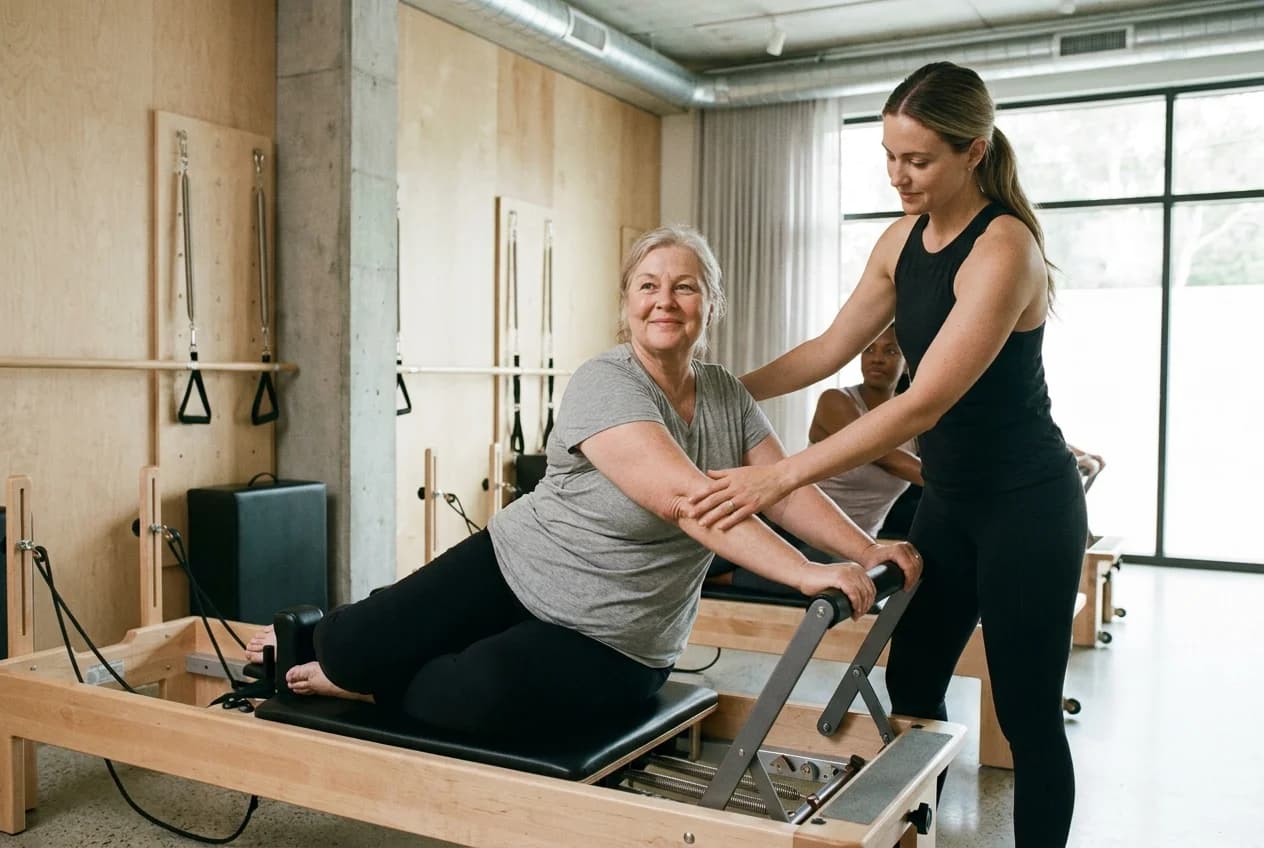
This guide is for educational discovery only. It is not medical advice. If you have pain, an injury, pregnancy, postnatal considerations, or a specific medical concern, speak to a qualified Pilates instructor or appropriate healthcare professional before trying new exercises or progressions.
Quick Answer
Progress safely in reformer Pilates by improving control first: quiet carriage return, steady breathing, clear setup, and organisation while the limbs move. Use beginner foundations such as Footwork Series, Bridging on Reformer, Hundred Prep, and Frog in Straps before intermediate work like Elephant, Scooter, Side Splits, or Leg Circles in Straps. If control is lost, reduce range, adjust springs, or return to a preparation exercise.
What Safe Progression Means
Safe progression does not mean avoiding challenge. It means choosing challenge that you can still control. On the reformer, control is visible: the carriage should return smoothly, the straps should not pull unevenly, and the trunk and pelvis should stay organised while movement happens.
Safe progression usually prioritises:
- understanding setup before speed
- quality over repetition count
- feedback from the equipment over appearance
- instructor guidance for spring settings and modifications
- regression when control is lost
Unsafe progression often looks like:
- rushing to intermediate exercises before foundations are stable
- adding range or springs because others in class are doing so
- pushing through pain, confusion, or instability
- copying shape without understanding purpose
For exercise pathways, see Beginner to Intermediate Reformer Pilates Exercises.
The Safe Progression Checklist
Use this checklist before advancing an exercise, range, or spring setting.
1. Setup is understood
Can you set up the exercise with minimal correction? If setup still feels confusing, progression may be premature.
Example: understanding foot placement in Footwork Series before Scooter.
2. Carriage control is smooth
Does the carriage return quietly and evenly? Banging, jerking, or uneven movement suggests control is not yet established.
Example: smooth press and return in Footwork Series before Elephant.
3. Breathing stays steady
Can you breathe through the movement without holding or straining? Breath loss often signals overload.
Example: steady breath in Hundred Prep before larger strap work.
4. Pelvis and trunk stay organised
Do the pelvis, ribs, and shoulders shift more than intended? If yes, reduce range or stay on a preparation exercise.
Example: stable pelvis in Frog in Straps before Leg Circles in Straps.
5. Straps feel predictable
Do the straps pull evenly and feel manageable? Uneven strap pull is a common sign to reduce range or spring load.
6. Purpose is clear
Can you explain what the exercise is teaching? Progression without purpose often leads to compensation.
7. Instructor agrees
A qualified instructor can confirm readiness, spring settings, and modifications for your circumstances.
How To Use Spring Settings Safely
Spring settings change support and resistance. They are a progression lever, not a badge of level.
Safe spring principles:
- ask whether the spring is supporting control or challenging it
- change one variable at a time—springs, range, or position—not all at once
- fewer springs can feel harder in some positions and easier in others
- more springs can add support in some exercises and overload in others
- spring choice depends on body position, exercise, and cueing intent
Examples:
- Footwork Series may use different springs to teach press or return control
- Frog in Straps may need enough support for controlled hip movement
- Elephant and Scooter may need springs that allow smooth carriage return without collapse
Never treat “heavier springs” as the goal. Treat controlled movement as the goal.
Safe Progressions With Example Exercises
These examples show sensible order. Your instructor may adapt them.
Footbar foundations first
1. Footwork Series — learn carriage and footbar feedback 2. Bridging on Reformer — add pelvic and trunk control 3. Scooter or Elephant — less supported footbar work when control is established
Core support before complexity
1. Hundred Prep — breath and trunk support 2. Bridging on Reformer — connect core with posterior chain 3. Frog in Straps — maintain organisation while legs move
Related: How Reformer Pilates Trains Core Control, Core Stability vs Core Strength in Pilates
Strap progressions
1. Frog in Straps — smaller controlled hip path 2. Leg Circles in Straps — larger path only when pelvis stays steady
Hip mobility with control
1. Frog in Straps 2. Bridging on Reformer 3. Side Splits — lateral work when standing control is ready
Mobility progressions should still respect stability. See Hip mobility.
Red Flags: When To Slow Down Or Stop
Slow down, modify, or stop and ask for guidance if:
- sharp pain or unexpected discomfort appears
- the carriage feels unsafe or uncontrollable
- straps pull strongly to one side
- you feel dizzy, unstable, or unsure in standing work
- neck, jaw, or lower-back tension increases sharply
- you hold breath to complete the movement
- you cannot reduce range and still feel in control
- setup changes every rep because position is lost
Stopping is not failure. It is appropriate response to feedback.
If symptoms persist outside class, consult an appropriate healthcare professional. This guide does not diagnose or treat conditions.
Common Progression Mistakes
Chasing harder exercises too soon
Elephant, Side Splits, and Leg Circles in Straps may look like the next step, but they require foundations from Footwork Series, Hundred Prep, or Frog in Straps.
Increasing range before control
A larger range is not automatically better. Smaller range with quality is often the safer progression.
Changing springs without understanding why
Spring changes should have a purpose—support, challenge, or teach carriage return—not mimic what someone else used.
Skipping footbar learning
Many users benefit from footbar confidence before strap-heavy work. See How to Choose Beginner-Friendly Reformer Exercises.
Comparing progress to others
Reformer progression is individual. Two people in the same class may need different exercises, ranges, and spring settings.
Ignoring equipment feedback
The reformer tells you when control is lost. Listen to carriage noise, strap pull, and shifting pelvis or ribs.
What To Ask An Instructor
Useful questions include:
- Am I ready to progress this exercise today?
- Should I progress by range, springs, or body position?
- What preparation exercise would make this safer?
- Which spring setting supports control for my level?
- What should I feel working, and what should stay quiet?
- How do I know if I am compensating?
- Can I stay on Footwork Series or Frog in Straps for another session?
- What is the smallest progression step from here?
If you are unsure, ask for a modification. Safe practice is built on clarity, not pressure.
FAQs
How do I know when I am ready to progress in reformer Pilates?
You may be ready when setup feels clear, the carriage returns smoothly, breathing stays steady, and the trunk and pelvis remain organised through the movement. Instructor confirmation helps, especially before less supported exercises.
Is it safe to progress every week?
Not necessarily. Some weeks control improves; other weeks fatigue, stress, or unfamiliar setup may mean staying at the same level is safer. Progress when quality improves, not on a fixed schedule.
What should I do if an intermediate exercise feels too hard?
Reduce range, adjust springs, ask for an easier variation, or return to a preparation exercise such as Footwork Series or Frog in Straps. See Beginner to Intermediate Reformer Pilates Exercises.
Are strap exercises safe for beginners?
Some strap exercises can be appropriate with good setup and spring guidance. Frog in Straps is a common starting point because the body remains supported while the user learns strap feedback.
Should I progress springs or exercises first?
Usually change one variable at a time. Your instructor may adjust springs on the same exercise before moving to a new exercise entirely.
What if I feel neck or lower-back tension during progression?
Stop and ask for guidance. The exercise may need a smaller range, different spring setting, clearer breath cues, or a return to a preparation exercise. Do not push through pain.
Can I progress safely at home on my own reformer?
Home practice can be useful, but safe progression still benefits from qualified instruction—especially for spring settings, setup, and intermediate exercises such as Side Splits or Scooter.
Where should I go next?
Read Reformer Pilates Exercise Progressions for the full progression framework, or Beginner to Intermediate Reformer Pilates Exercises for exercise-by-exercise pathways.
Explore next
Related guides
- Reformer Pilates Exercise Progressions
- Beginner To Intermediate Reformer Pilates Exercises
- How To Choose Beginner Friendly Reformer Exercises
- Beginner Reformer Pilates Exercises
- Reformer Pilates For Beginners
- Reformer Pilates Core Strength
- Core Stability Vs Core Strength In Pilates
- How Reformer Pilates Trains Core Control